Author: admin

  • Do Sun-Dried Tomatoes Go Bad? Shelf Life, Spoilage Signs & Storage Tips

    🍅 The Short Answer

    Do sun-dried tomatoes go bad? Yes, but the timeline depends almost entirely on what type you have and how you store them. Dry-packed sun-dried tomatoes are among the most shelf-stable pantry ingredients you can own. Oil-packed ones are more perishable once opened, and homemade versions in oil carry a food safety consideration that most storage guides skip entirely.

    Understanding the difference between the two types is the most important thing here. They behave very differently in storage, and the rules for one do not apply to the other. For a broader look at how to store pantry condiments and staples, see our Food Storage Guide.

    Short answer: Unopened dry-packed sun-dried tomatoes last 9 to 12 months at room temperature and up to 2 years refrigerated. Unopened oil-packed jars last 1 to 2 years in the pantry. Once opened, oil-packed must be refrigerated and used within 6 months. Dry-packed opened keep 6 to 9 months in an airtight container.

    📅 Sun-Dried Tomato Shelf Life at a Glance

    Type & Condition Pantry Refrigerator
    Dry-packed, unopened 9 to 12 months Up to 2 years
    Dry-packed, opened 6 to 9 months (airtight container) Up to 1 year
    Oil-packed, unopened 1 to 2 years Beyond best-by date; quality declines over time
    Oil-packed, opened Not recommended Up to 6 months
    Homemade in oil (plain, fully dried, no garlic or fresh herbs) Up to 6 months if fully dried 1 to 2 months after opening
    Homemade in oil with garlic or fresh herbs Not safe — refrigerate only 4 days maximum
    Frozen (either type) Up to 1 year

    🫙 Dry-Packed vs Oil-Packed: Why It Matters

    Dry-packed sun-dried tomatoes are sold in bags or vacuum-sealed pouches and look like dried fruit: leathery, shrunken, and intensely colored. Because nearly all their moisture has been removed during drying, there is very little water available for mold or bacteria to grow. This makes them remarkably shelf-stable. Stored in a cool, dark pantry in an airtight container after opening, they will stay good for the better part of a year.

    Oil-packed sun-dried tomatoes are softer, already partially rehydrated, and submerged in olive oil, often with garlic, herbs, or other seasonings. The oil creates an anaerobic (low-oxygen) environment that extends shelf life when sealed but requires careful handling once opened. Once air gets into the jar, the clock starts. They must be refrigerated and kept fully submerged in oil at all times.

    ⚠ The Food Safety Warning Most Guides Skip

    This section matters most for anyone making sun-dried tomatoes at home or adding fresh ingredients to a store-bought jar.

    Clostridium botulinum, the bacterium that produces botulism toxin, thrives in anaerobic (low-oxygen) environments like oil. Fully dried tomatoes on their own are acidic enough to provide some protection in that environment. But adding fresh garlic, fresh herbs, or other low-acid ingredients to a jar of oil creates conditions where botulism can develop.

    The Oregon State University Extension Service is explicit on this point: dried tomatoes packed in oil with garlic or herbs must be refrigerated and used within 4 days. The National Center for Home Food Preservation (NCHFP) recommends against storing any homemade tomatoes in oil, noting that oil can protect botulism organisms trapped in water droplets even when other conditions appear safe.

    Commercial oil-packed sun-dried tomatoes are produced under controlled pH and processing conditions that address this risk. The 4-day rule applies to homemade preparations and to store-bought jars where fresh garlic or fresh herbs have been added after opening.

    🌡 A Normal Thing People Mistake for Spoilage: Solidified Oil

    This is the most common reason people throw out perfectly good oil-packed sun-dried tomatoes. When refrigerated, olive oil solidifies. The jar will look cloudy, opaque, or waxy, and the oil may form small white beads or crystals around the tomatoes. This is completely normal: it is the natural physical behavior of olive oil at cold temperatures.

    To use, remove the jar from the fridge and let it sit at room temperature for 20 to 30 minutes. The oil will return to liquid and the tomatoes will be easy to remove. Bella Sun Luci, one of the leading commercial producers of oil-packed sun-dried tomatoes, confirms this is an expected and natural process and not a sign of spoilage.

    🔍 How to Tell If Dry-Packed Tomatoes Have Gone Bad

    The main enemies of dry-packed sun-dried tomatoes are moisture and age. If they were stored somewhere humid or the bag seal was broken and exposed to air for a long time, quality declines noticeably:

    • Visible mold: white, green, or fuzzy growth on the surface
    • Slimy or unusually wet texture (moisture got in)
    • Sour, fermented, or off smell that is distinct from the normal concentrated tomato aroma
    • Extremely hard, brittle texture with no pliability at all
    • Insects or evidence of pantry pests in the bag

    Slight hardening over time is not automatic spoilage. Dry-packed tomatoes can be rehydrated in warm water or broth for 20 to 30 minutes to restore their texture. If they smell off or show any mold, discard them.

    🔍 How to Tell If Oil-Packed Tomatoes Have Gone Bad

    • Visible mold on the tomatoes or on any part sitting above the oil
    • Bubbling or fizzing in the jar: a sign of yeast or bacterial activity, discard immediately
    • Sour, rancid, or fermented smell that does not resemble normal olive oil or tomatoes
    • Slimy film on the surface of the oil or on the tomatoes
    • Rancid-tasting oil: the oil itself can go off even if the tomatoes look fine

    Normal and not spoilage:

    • Solidified, cloudy, or opaque oil in the fridge: this is just cold olive oil behaving normally
    • Darker color on the tomatoes compared to when you first opened the jar: normal oxidation
    • Oil that has taken on a reddish or orange tint: the tomatoes have infused it, and that oil is excellent for cooking

    🫙 The Key Storage Rule for Oil-Packed: Keep Them Submerged

    Any tomato sitting above the oil line and exposed to air is at risk of mold. Every time you use some, check that the remaining tomatoes are fully covered. If the level drops, top up the jar with fresh olive oil before returning it to the fridge. This one habit makes the difference between a jar that lasts 6 months and one that grows mold at 6 weeks.

    Always use a clean, dry utensil when removing tomatoes. Never use fingers or a wet spoon. Introducing water into an oil-packed jar is one of the fastest ways to cause early spoilage.

    ❓ Frequently Asked Questions

    Can you eat sun-dried tomatoes that have turned very dark?
    Dry-packed tomatoes naturally darken over time due to oxidation. A very dark brownish-red color is normal and does not mean they are bad. Smell them first. If they still smell like concentrated tomatoes, they are fine to eat.

    My dry-packed tomatoes have gone very hard. Are they ruined?
    Not necessarily. Hardening happens when moisture has been drawn out further over time. Try rehydrating a few in warm water for 20 to 30 minutes. If they soften and smell normal, they are fine to use. If they do not rehydrate or smell off, discard them.

    Can I use the oil from an oil-packed jar?
    Yes. The tomato-infused oil is excellent in salad dressings, as a pasta finish, or for sautéing aromatics. Use it while the jar is within its window and the oil smells fresh. Do not use oil that has gone rancid even if the tomatoes still look okay.

    How long do sun-dried tomatoes last after the best-by date?
    Dry-packed varieties are often fine 3 to 6 months past the printed date if stored properly and the bag was never opened. Oil-packed unopened jars can be fine 6 to 12 months past the date. Once opened, follow the type-specific storage guidelines above rather than the printed date.

    Can I freeze sun-dried tomatoes?
    Yes. Dry-packed tomatoes freeze well in a sealed freezer bag with air removed for up to a year. For oil-packed, remove from the oil, pat dry, and freeze in a single layer before transferring to a container. Both thaw quickly at room temperature.

    What does it mean if my oil-packed jar is bubbling?
    Bubbling or fizzing is a sign of active fermentation: yeast or bacterial growth in the jar. Discard immediately without tasting.

    I added fresh garlic to my oil-packed jar. Is it still safe?
    Only if you refrigerate it immediately and use it within 4 days. Fresh garlic in oil at room temperature creates conditions where botulism can develop. The Oregon State University Extension Service is explicit about this rule. Refrigerate and use within 4 days, or discard.

    🧂 Related Food Storage Guides

    🍳 Recipes That Use Sun-Dried Tomatoes

    The post Do Sun-Dried Tomatoes Go Bad? Shelf Life, Spoilage Signs & Storage Tips appeared first on Better Living.

  • Do Sun-Dried Tomatoes Need to Be Refrigerated? Full Storage Guide

    🌡 The Short Answer

    Do sun-dried tomatoes need to be refrigerated? It depends on the type. Dry-packed sun-dried tomatoes do not need refrigeration before or after opening. Oil-packed sun-dried tomatoes do not need refrigeration before opening, but must be refrigerated once the seal is broken. Homemade sun-dried tomatoes in oil follow stricter rules depending on what else is in the jar.

    Getting this wrong in either direction causes problems. Leaving oil-packed open at room temperature risks spoilage and a potential food safety issue. Over-refrigerating dry-packed tomatoes is not harmful but can introduce moisture if the container is not well sealed. For a broader look at storing pantry staples, see our Food Storage Guide.

    Short answer: Dry-packed: no refrigeration needed, opened or unopened. Oil-packed unopened: pantry is fine. Oil-packed opened: refrigerate immediately, keep tomatoes submerged in oil, use within 6 months.

    📋 Sun-Dried Tomato Storage Quick Reference

    Type Unopened After Opening
    Dry-packed (bag or pouch) Cool, dark pantry — no fridge needed Airtight container, pantry or fridge — 6 to 9 months
    Oil-packed (commercial jar) Pantry — no fridge needed Refrigerate — up to 6 months, keep submerged in oil
    Homemade in oil (plain, fully dried, no garlic or fresh herbs) Cool, dark place if fully dried — up to 6 months Refrigerate — 1 to 2 months
    Homemade in oil with garlic or fresh herbs Refrigerate immediately — 4 days maximum Refrigerate — 4 days maximum

    🛍 Dry-Packed: No Refrigeration Required

    Dry-packed sun-dried tomatoes have had nearly all their moisture removed during the drying process. Without moisture, there is very little for mold or bacteria to grow on, which makes them stable at room temperature for months.

    Store unopened bags in a cool, dark pantry away from heat sources. After opening, transfer to an airtight container and return to the pantry or a kitchen cabinet. The goal is to keep moisture out: that is the only real threat to dry-packed tomatoes. A humid cabinet near the stove or sink is worse for storage than a slightly warmer but drier shelf.

    Refrigerating dry-packed tomatoes is not harmful, but it is unnecessary and has a small downside. Condensation can form when you take the container in and out of the fridge, introducing the moisture you are trying to avoid. If you do refrigerate them, make sure the container is very well sealed.

    🫙 Oil-Packed: Refrigerate After Opening

    Unopened commercial jars of oil-packed sun-dried tomatoes are shelf-stable and do not need refrigeration. The oil barrier, the tomatoes’ natural acidity, and commercial processing make them stable in a pantry for 1 to 2 years.

    Once you open the jar, refrigeration is necessary. The seal is broken, air can reach the tomatoes, and the conditions that made the jar shelf-stable no longer fully apply. Bella Sun Luci, one of the leading commercial producers, is explicit: all their oil-packed products must be stored in the refrigerator once opened and used within 6 months.

    The single most important habit for an opened oil-packed jar: keep the tomatoes submerged in oil at all times. Any tomato sitting above the oil line and exposed to air is at risk of mold growth. Top up the jar with fresh olive oil whenever the level drops before returning it to the fridge.

    🧊 Why the Oil Solidifies in the Fridge (And Why That’s Fine)

    Olive oil solidifies at cold temperatures. When you refrigerate an oil-packed jar, the oil will turn cloudy, opaque, or waxy, and may form small white beads or crystals around the tomatoes. This is not spoilage: it is the natural physical behavior of olive oil below around 50°F.

    To use, remove the jar from the fridge 20 to 30 minutes before you need it. The oil will return to liquid at room temperature and the tomatoes will be easy to retrieve. If you want the oil to stay more pourable, store the jar in the door of the fridge, which runs slightly warmer than the middle shelves.

    ⚠ Homemade Sun-Dried Tomatoes in Oil: Stricter Rules

    Commercial oil-packed sun-dried tomatoes are produced under controlled conditions that manage pH and moisture to prevent bacterial growth. Homemade versions do not have these controls, so the storage rules are different and in one specific case much stricter.

    Plain homemade (no garlic, no fresh herbs): Fully dried tomatoes packed in plain olive oil can be stored at room temperature for up to 6 months if the tomatoes were dried until completely leathery with no remaining moisture. The tomatoes’ acidity provides some protection. Refrigerate after opening and use within 1 to 2 months.

    With fresh garlic or fresh herbs: Fresh garlic and fresh herbs in oil create an anaerobic (low-oxygen) environment that can support Clostridium botulinum, the bacterium that produces botulism toxin. The Oregon State University Extension Service is explicit: dried tomatoes in oil with fresh garlic or herbs must be refrigerated and used within 4 days. The National Center for Home Food Preservation recommends against storing any homemade tomatoes in oil, noting that oil can protect botulism organisms trapped in water droplets even when conditions otherwise appear safe.

    If you want to flavor your oil-packed tomatoes with garlic, use dried garlic powder rather than fresh, or refrigerate and use within 4 days. The 4-day rule applies to homemade preparations only. Commercial jars with garlic listed in the ingredients have been processed to control for this risk.

    🌡 Best Fridge Storage Practices for Oil-Packed

    Use a clean, dry utensil every time. Never use fingers or a wet spoon. Water introduced into an oil-packed jar gives mold something to grow on and dramatically shortens the jar’s life.

    Keep tomatoes submerged. Check the oil level every time you use the jar. Top up with fresh olive oil if needed before putting the jar back in the fridge.

    Do not return drained oil to the jar. Oil that has been poured out and exposed to other ingredients should not go back in. Only add fresh olive oil to top up the level.

    ✅ Signs Your Stored Sun-Dried Tomatoes Are Still Good

    • Dry-packed: pliable or slightly firm, deep red-brown color, concentrated tomato smell
    • Oil-packed: tomatoes fully submerged, oil clear at room temperature (or solidified in fridge: normal), no bubbling
    • Both: rich, slightly sweet, tangy concentrated tomato aroma
    • No visible mold anywhere in the jar or bag

    ❌ Signs to Discard

    • Visible mold on tomatoes or inside the jar
    • Bubbling or fizzing in an oil-packed jar: discard immediately without tasting
    • Slimy film on tomatoes or oil surface
    • Rancid, sour, or fermented smell
    • Dry-packed tomatoes that are wet, sticky, or have a musty smell

    ❓ Frequently Asked Questions

    Can I leave oil-packed sun-dried tomatoes out overnight after opening?
    A few hours at room temperature while cooking is fine. Leaving them unsealed on the counter overnight is not recommended. The bigger concern is not a single night at room temperature but ongoing air and moisture exposure over weeks.

    My oil-packed jar has been in the fridge for 8 months. Is it still good?
    Check the smell first. If the oil smells fresh and the tomatoes look and smell normal with no mold, it may still be okay. Six months is a quality guideline, not a hard cutoff, but at 8 months inspect carefully and trust your senses.

    Can I store dry-packed tomatoes in the freezer?
    Yes. Sealed in a freezer bag with air removed, they last up to a year with no quality loss. Thaw at room temperature for 20 minutes or rehydrate directly from frozen in warm water.

    The oil in my jar has gone very dark red. Is that spoilage?
    No. This is the tomatoes infusing their color into the oil over time. Dark red or orange-tinted oil is normal and desirable. The infused oil is excellent for cooking. If the oil smells rancid rather than tomatoey, that is a separate issue.

    I store my oil-packed jar in the pantry after opening. Is that okay?
    For commercial jars, a few days at room temperature is unlikely to cause a problem but is not recommended. Over weeks, the risk of mold grows significantly. Refrigerating after opening gives you a 6-month window instead of a much shorter and riskier pantry window.

    🧂 Related Food Storage Guides

    🍳 Recipes That Use Sun-Dried Tomatoes

    The post Do Sun-Dried Tomatoes Need to Be Refrigerated? Full Storage Guide appeared first on Better Living.

  • “I Chose To Stay Home With The Kids. Now I’m Freaking Out.”

    “I Chose To Stay Home With The Kids. Now I’m Freaking Out.”

    I Chose To Stay Home With The Kids. Now I'm Freaking Out.

    A few months ago, we asked you what money questions are on your mind. We got nearly a thousand responses, and one theme that came up over and over was the financial trickiness of being a stay-at-home parent.… Read more

    The post “I Chose To Stay Home With The Kids. Now I’m Freaking Out.” appeared first on Cup of Jo.

  • Is Analog the Future?

    Is Analog the Future?

    The future is analog!

    Doesn’t that sound backwards? But have you heard of this?

    On Friday I attended a neighborhood gathering. The beautiful warm weather has a grip on us all and encouraged a large attendance for the snack and chat event.

    I ended up speaking with some of my favorite ladies that are in a life stage beyond mine and had a downright wonderful time as we discussed hobbies. It wasn’t an intentional discussion on hobbies but the conversation naturally wove through garden prep to sourdough to needlepoint and antique shops. We have a lot of things we enjoy in common!

    One woman even mentioned that her daughter taught her a new trending word for all these hobbies she enjoys- analogging.

    .

    Have you heard of this?

    I’ve heard the term “grandma hobbies” and “going analog” but whatever you call it, I’ve also witnessed an increased trend in these hands-on, non-digital based ways to spend time. Analog hobbies help break the dependency on screen based entertainment and the “doom scrolling” that is so easy to fall victim to these days. And I am here for it!

    What are Analog Hobbies?

    • Cooking and baking
    • Gardening
    • Needlepoint, knitting, crocheting, sewing
    • Reading books
    • Coloring
    • Junk journaling
    • Jigsaw puzzles
    • Walking and hiking
    • Crossword puzzles or sudoku

    I would like to add blog reading and Substack to the list because even though it’s digital, it feels more analog to me check to in on someone’s life and thoughts through a written medium. I might even add phone calls or Marco Polo because those methods of connection I’ve found to be very fulfilling.

    I do think it’s funny that this is trending though. I thought it was something I was just being drawn to in my own life, but it’s neat to hear that I’m not the only one experiencing digital fatigue and finding respite in slower living. It really does feed the soul.

    Going analog isn’t about going full on Little House on the Prairie, but it is about finding something to reach for beyond a screen. It’s about rediscovering the satisfaction and peace that comes with accomplishing something with your own two hands: a meal, a piece of art, a cozily decorated spot in your home, a plant thriving, a completed puzzle, a clean chicken coop (just me?).

    And with that, I’m off to feed my starter!

    Have you heard of this trend?
    Is there any analog hobbies you’ve rediscovered peace and joy with lately?

  • Are the Relentless Consumer Surveys Annoying You?

    Are the Relentless Consumer Surveys Annoying You?

    Feedback fatigue is a real thing.

    “How was your purchase?” “How was your return?” “How was your meal?” “Did the staff smile?” If it feels like every transaction now comes with a request for feedback, you’re not imagining it. Businesses increasingly rely on customer surveys to measure satisfaction and loyalty, and consumers are being asked to respond to them everywhere—from restaurants and retailers to doctors’ offices and repair shops. The problem is that the volume of these requests is beginning to overwhelm the very people they are meant to learn from.

    I rarely respond to a request for feedback, but I feel guilty when I delete it.  I am one of many consumers who read the reviews of products and restaurants, so I understand their importance. It’s not that I don’t want to help the businesses, it’s that I am short on time, and there are so many surveys. I also don’t want to give them more information about me.  Questions like “how likely are you to return to this restaurant?’ or ‘how often do you buy shoes?’ unnerve me. The other aspect of the reviews is you don’t know how long the survey is, and I feel stuck when I’ve already invested thoughtful time on the first 7 questions, and then discover I’m only halfway through.

    Survey fatigue or survey exhaustion is a common response from consumers who feel relentlessly requested to complete surveys about their recent transactions.  Consumer patience with the surveys has been waning for over a decade. Survey requests doubled between 2023 and 2025, making consumers ignore, delete, or mark the surveys as spam. The result for businesses is poor data quality, low response rates, and consumers potentially abandoning the brand.

    Sometimes the business can be downright annoying in their pursuit of a review. That approach is backfiring and causing many customers to reduce their use of the offending company.  As a result, businesses are also slowing down their pursuit of reviews, and that’s a good thing.

    How many surveys are out there?  One small company that conducts and analyzes electronic surveys says it completes more than 60 million annually.  And there are many other small and large firms doing the same work!

    Why all the surveys?  Businesses want to lock in customer loyalty. They think surveys will allow them to learn about their customers and how the business can please them.  The question is, are the surveys giving businesses the wrong information about consumers??

    Survey response rates are declining, but even when customers do complete the surveys, research is showing that their results are not reliable.  Consumers often make irrational purchases, but when they complete surveys, they are thoughtful and not impulsive. That does not give businesses future predictions of their purchases.

    • Approximately 23% of customers have stopped doing business with a brand specifically because it sent too many surveys.
    • When fatigued, only the most “extremely” satisfied or dissatisfied customers respond, creating a biased data set that misses the “silent majority”.
    • Respondents who do participate often “straight-line” (select the same answer for everything) or rush through to finish, making the resulting insights unreliable.
    • Frequent requests can make a brand appear intrusive, unprofessional, and indifferent to the customer’s time.
    • If given the opportunity to add information, customers should let the business know they send too many surveys.

    What can businesses do to alleviate survey fatigue?

    • Respect customer time. Be selective and do not ask for feedback after every transaction.
    • Aim for under 5 minutes and 5-10 questions.
    • Rely on actual customer actions rather than just asking opinions.
    • Ask relevant, targeted questions based on the specific experience.
    • Show customers how their feedback led to improvements.
    • Leverage social media monitoring or unsolicited feedback instead of formal surveys.


    For a laugh, watch this Saturday Night Live skit with Jake Gyllenhaal dealing with customer service. (note:  it’s rated R)


    The post Are the Relentless Consumer Surveys Annoying You? appeared first on Sharp Eye.

  • Does Sriracha Need to Be Refrigerated? Full Storage Guide

    ❄ The Short Answer

    Does sriracha need to be refrigerated? No, sriracha does not require refrigeration, even after the bottle has been opened.

    According to Huy Fong Foods, the maker of the most widely used sriracha, their products simply need to be stored in a cool, dry place. The vinegar base, capsaicin from the chilies, and added preservatives make the sauce shelf-stable at room temperature.

    That said, refrigeration is genuinely worth doing if you go through a bottle slowly. Cold storage slows oxidation, keeps the color brighter, and prevents the heat level from intensifying as quickly. You don’t have to refrigerate it, but if your bottle sits on the shelf for more than a few months, the fridge will keep it noticeably better for longer.

    Short answer: No refrigeration needed — opened or unopened. Store at room temperature in a cool, dark place for up to 6–9 months of best quality. Refrigerate if you use it slowly and want to maintain color and flavor for 12–18 months.

    📋 Sriracha Storage Quick Reference

    Storage Method Quality Window Best For
    Pantry, unopened 2+ years Long-term storage, stockpiling
    Pantry, opened 6–9 months Daily or frequent users
    Refrigerator, opened 12–18 months Occasional users, color preservation
    Freezer (ice cube tray) Indefinite Bulk storage only
    Homemade sriracha, opened 1–3 months (fridge only) Must be refrigerated — no pantry storage

    🏭 What Huy Fong Actually Says

    Huy Fong Foods has confirmed directly that their sriracha does not require refrigeration. The recommendation on their website is to store the product in a cool, dry place. The best-by date is lasered onto the bottle near the neck. You can often feel it with your fingers before you can read it visually.

    This guidance applies to their complete product line, not just the original sriracha. The combination of distilled vinegar, capsaicin, potassium sorbate, and sodium bisulfite makes refrigeration a quality choice, not a safety requirement.

    🎨 The Real Reason to Refrigerate Sriracha

    Refrigeration doesn’t prevent spoilage in commercial sriracha. It slows two specific quality changes that happen when the opened bottle sits at room temperature:

    Color darkening. Sriracha oxidizes when exposed to air. Over several months at room temperature, the bright red fades to a darker brownish-red. This is purely aesthetic and does not affect safety, but if you want your sriracha to stay vibrant, the fridge significantly slows oxidation. The cold also limits light exposure, which accelerates the same process.

    Heat intensification. As sriracha ages, the chili compounds continue to develop. An older bottle at room temperature will typically taste hotter than a fresh one. Some people prefer this. But if you want consistent, predictable heat, cold storage slows the process considerably.

    If you use a bottle within two to three months, neither of these changes will be noticeable. If your bottle sits for six months or more, refrigeration makes a meaningful difference in both color and flavor.

    🌡 Where to Store Sriracha in the Fridge

    If you do refrigerate sriracha, store it in the door compartment rather than the main shelves. The door is slightly warmer than the interior, which keeps the sauce more pourable. Cold sriracha from the main fridge shelves can thicken enough to be difficult to squeeze from the bottle, especially in a squeeze bottle format. Door storage avoids this without sacrificing the temperature benefit.

    🏠 Homemade Sriracha: Different Rules

    Everything above applies to commercial sriracha. Homemade sriracha operates under entirely different storage rules and should always be refrigerated.

    Without potassium sorbate, sodium bisulfite, or industrial pH control, homemade sriracha relies entirely on the natural preservation from vinegar, salt, and capsaicin. That provides some protection, but nowhere near enough for room-temperature storage once opened. Homemade sriracha left at room temperature is at real risk of mold growth, especially in warmer kitchens.

    Refrigerate homemade sriracha immediately after making it and use it within 1 to 3 months. Keep it in a clean glass jar with a tight lid. Do not store it on the counter between uses.

    ⚠ Sriracha Mixed With Other Ingredients

    The moment you mix sriracha into another sauce — sriracha mayo, sriracha aioli, sriracha butter, or any dip — the shelf-stability rules change completely. The other ingredients (mayo, dairy, eggs) dominate and the sriracha’s preservative qualities no longer protect the mixture.

    Any sriracha-based sauce or dip must be refrigerated and used within 3 to 5 days. Do not store these at room temperature under any circumstances.

    ✅ Signs Your Stored Sriracha Is Still Good

    • Red to dark red color (some darkening from room temp storage is normal)
    • Spicy, tangy, garlicky smell — recognizably sriracha
    • Pours or squeezes normally once shaken
    • Tastes like sriracha — possibly hotter than when new, but not sour or off
    • No visible mold patches around lid or on surface

    ❌ Signs to Discard It

    • Any visible mold — white, green, black, or gray patches on surface or cap
    • Sour, fermented, or distinctly off smell
    • Sauce won’t recombine after shaking — stuck clumps or hardened texture
    • Genuinely bad taste, not just extra heat
    • Bottle appears swollen or damaged

    ❓ Frequently Asked Questions

    Will refrigerated sriracha get too thick to use?
    It can thicken slightly in the coldest part of the fridge, but the sauce itself doesn’t solidify. Storing it in the door (warmer zone) and giving it a shake before use is enough to keep it pourable. If it seems very thick, let it sit at room temperature for a few minutes before using.

    Should I refrigerate sriracha after every use or only for long-term storage?
    If you use it at least once a week, room temperature storage is fine for 6 to 9 months. If you use it occasionally and the bottle will sit for many months, put it in the fridge. The decision is purely about quality, not safety.

    Does refrigerating sriracha change the taste?
    Refrigeration doesn’t change the flavor profile, it preserves it. Room-temperature storage is what changes the taste over time (hotter, more vinegary, less fresh). Cold storage maintains the original flavor more faithfully.

    Can I leave sriracha out on a restaurant table indefinitely?
    Restaurants do this routinely with commercial sriracha. It’s safe and standard practice. High-turnover bottles in busy restaurants get replaced often enough that quality doesn’t degrade significantly. A home bottle left on the counter for six months is a different situation than a restaurant bottle used many times a day.

    Does the brand matter for whether to refrigerate?
    It matters for homemade or artisan srirachas with fewer preservatives, these need refrigeration. Commercial brands like Huy Fong with added preservatives are genuinely shelf-stable. Always check the label on smaller brands for their specific storage guidance.

    What about the USDA’s recommendation?
    The USDA FoodKeeper app recommends using opened chili sauces within 6 months at room temperature — a conservative quality guideline, not a strict safety cutoff. Most commercially produced sriracha will remain good beyond this window, but 6 months is a reasonable target for best flavor.

    🧂 Related Food Storage Guides

    🍳 Recipes That Use Sriracha

    The post Does Sriracha Need to Be Refrigerated? Full Storage Guide appeared first on Better Living.

  • Does Sriracha Go Bad? Shelf Life, Spoilage Signs & Storage Tips

    🌶 The Short Answer

    Does sriracha go bad? Yes, but very slowly, and almost never in a way that makes it unsafe to eat.

    Sriracha is built to last. Its main ingredients (chili peppers, distilled vinegar, salt, and garlic) are all natural preservatives, and commercial brands like Huy Fong add potassium sorbate and sodium bisulfite on top of that. The result is one of the most shelf-stable condiments in your kitchen.

    What actually happens over time is quality decline, not spoilage. The color shifts from bright red toward a darker brownish-red. The heat level changes, and not in the direction most people expect. The bigger concern is knowing the difference between a bottle that’s genuinely gone bad versus one that’s just aged normally.

    Short answer: An unopened bottle of sriracha lasts 2 years or more at room temperature. Once opened, it stays good for at least 6 months at room temp and over a year refrigerated. It rarely spoils in a way that’s unsafe, but it will lose quality and change character over time.

    📅 Sriracha Shelf Life at a Glance

    Condition Pantry Refrigerator
    Unopened (commercial) 2+ years Indefinite
    Opened (commercial) 6–9 months (best quality) 12–18 months
    Past best-by date (unopened) Often fine 6–12 months beyond
    Homemade sriracha (opened) Not recommended 1–3 months
    Sriracha mayo or mixed sauces Not safe 3–5 days only

    These figures apply to Huy Fong and comparable commercial brands. The 6–9 month pantry window is Huy Fong’s own recommendation for best flavor — the sauce won’t suddenly become unsafe the day it hits month 10, but quality will be noticeably different.

    🔬 Why Sriracha Lasts So Long

    Three things work together to make sriracha exceptionally shelf-stable:

    Distilled vinegar. Vinegar is a natural antimicrobial. Its acidity (low pH) creates an environment where most bacteria and mold cannot survive. This is the same reason vinegar-based hot sauces outlast dairy-based or fruit-based ones by a wide margin.

    Capsaicin. The compound that makes chili peppers hot also has antimicrobial properties. Capsaicin inhibits bacterial growth across a wide range of pathogens, which is part of why pure hot sauces have historically been used as food preservatives in warm climates. A 2023 review published in Nutrients confirms capsaicin’s antibacterial and antifungal activity against bacteria including Salmonella, E. coli, and Staphylococcus aureus.

    Added preservatives. Commercial sriracha (Huy Fong and most other brands) includes potassium sorbate and sodium bisulfite. These extend shelf life further and slow the color and flavor changes that happen with air exposure. Homemade sriracha has none of these, which is why it needs refrigeration and has a much shorter window.

    🌡 Why Sriracha Gets Spicier Over Time

    This surprises most people. As sriracha ages, the bright, fresh chili and garlic notes tend to degrade faster than the capsaicin itself, which shifts the flavor balance. That means an older opened bottle will typically taste hotter than a fresh one, even if the total capsaicin content hasn’t changed. Huy Fong notes this directly: the sauce may become spicier as the chilis age. This is a quality change, not a safety issue, but it’s worth knowing if you find your sriracha seems more intense than you remember.

    Refrigeration slows this process significantly. If you prefer consistent heat, keep the bottle cold.

    🎨 Color Change: Normal or Spoilage?

    Color darkening is one of the most common reasons people throw out perfectly good sriracha. It is almost always normal.

    Fresh sriracha is a vibrant, bright red. Over time, typically after several months opened at room temperature — it shifts toward a deeper, more muted brownish-red. This is oxidation, the same chemical process that darkens cut apples, avocado, and most other red or orange foods when exposed to air. It does not mean the sriracha has spoiled.

    The color change happens faster at room temperature and slower in the refrigerator, which is the main practical reason to refrigerate an opened bottle even though it is not required for safety.

    The only color change that signals a real problem: patches of a different color (white, green, black, gray) that look like mold growth on the surface or around the lid. That is not oxidation. That is contamination, and the bottle should be discarded.

    🧫 Sauce Separation: Is It Spoilage?

    You may notice some liquid sitting at the top of a bottle that has been stored for a while. This is normal separation, the water content migrates away from the denser solids. It is not a sign the sauce has gone bad. Shake the bottle well before using and the sauce will recombine.

    Separation that cannot be recombined by shaking. Thick clumps, hardened solids that won’t break up, or a texture that seems fundamentally different from what you bought is a different matter and worth inspecting more carefully alongside the smell and taste.

    🏠 Homemade vs. Store-Bought: A Key Difference

    Commercial sriracha is formulated for shelf stability. Homemade sriracha is not. Without industrial preservatives, homemade versions rely entirely on the natural preservation from vinegar, salt, and capsaicin — which is meaningful but limited.

    Homemade sriracha should always be refrigerated and used within 1 to 3 months. Do not leave it at room temperature. The same applies to any sriracha-based sauce you make at home. Sriracha mayo, sriracha aioli, sriracha butter — all of these need refrigeration and have a window of just a few days.

    ✅ Signs Sriracha Is Still Good

    • Bright to medium-dark red color (some darkening is normal)
    • Pours or squeezes normally from the bottle
    • Smells spicy, tangy, and garlicky — recognizably like sriracha
    • Tastes as expected, possibly hotter than when new
    • No visible growth around the lid or on the surface

    ❌ Signs Sriracha Has Gone Bad

    • Visible mold — any color other than red — on the surface or around the lid
    • Sour, fermented, or off smell that doesn’t resemble normal sriracha
    • Texture that has thickened to the point the sauce won’t pour or shake loose
    • Taste that is genuinely off — not just hotter, but sour or unpleasant
    • Bottle that looks swollen, leaking, or damaged before opening

    📍 Finding the Best-By Date on a Huy Fong Bottle

    The best-by date on Huy Fong sriracha is not printed in an obvious spot. It is lasered directly onto the bottle near the neck. You can often feel the slight impression with your fingers more easily than you can read it visually. If you can’t find it, that’s why.

    The date is a best-quality guideline, not a safety cutoff. An unopened bottle stored in a cool, dark pantry is typically still fine 6 to 12 months past the printed date, especially if the bottle is intact and the seal has never been broken.

    ❓ Frequently Asked Questions

    Can sriracha make you sick?
    Properly stored sriracha that has not developed mold or an off smell is extremely unlikely to make you sick. The vinegar and preservatives make it inhospitable to harmful bacteria. The greater risk is from cross-contamination — double-dipping a utensil into the bottle repeatedly introduces bacteria from other foods.

    Why does my sriracha smell more vinegary than usual?
    As sriracha ages, the chili and garlic compounds break down while the vinegar becomes more prominent. A more vinegary smell in an older bottle is normal quality decline, not spoilage — as long as there’s no mold and the sauce still tastes like sriracha.

    Does freezing sriracha work?
    Yes, but it requires a bit of effort. The sauce won’t freeze solid in a standard bottle (the vinegar lowers the freezing point), but for long-term storage you can freeze it in an ice cube tray and transfer the cubes to an airtight bag. It keeps indefinitely frozen and thaws quickly. Most people won’t need this unless they buy in bulk.

    Is sriracha still good if the cap has dried sauce on it?
    Dried sauce around the cap is normal. Wipe it clean before using to avoid introducing dried, potentially contaminated material back into the bottle. The sauce inside is unaffected.

    Does the type of sriracha brand matter for shelf life?
    Brands that include added preservatives (potassium sorbate, sodium bisulfite) like Huy Fong will last longer than brands with a simpler, more natural ingredient list. Always check the label. Artisan or small-batch srirachas with fewer preservatives are closer to homemade in terms of shelf life and should be treated accordingly.

    Can I use sriracha that’s turned brown?
    Yes, in almost all cases. Browning is oxidation, not spoilage. The flavor will be somewhat different — usually hotter and with a more muted freshness — but it is safe to eat. If the only issue is color, use it up and buy a fresh bottle when it runs out.

    My sriracha is past its best-by date but smells and tastes fine. Is it okay?
    Yes. The best-by date reflects peak quality, not a safety threshold. If it smells like sriracha, tastes like sriracha, has no mold, and pours normally, it is fine to use.

    🧂 Related Food Storage Guides

    🍳 Recipes That Use Sriracha

    The post Does Sriracha Go Bad? Shelf Life, Spoilage Signs & Storage Tips appeared first on Better Living.

  • International Women’s Day!

    International Women’s Day!

    Wishing all the ladies a very happy International Women’s Day!

    Today is our day, and we make a difference in the world!

  • How to Get Tomato Sauce Out of Clothes: What Actually Works

    How to Get Tomato Sauce Out of Clothes: What Actually Works

    Learning how to get tomato sauce out of clothes is one of those skills you pick up the hard way. Usually mid-dinner, and usually on something white.

    One second I was serving spaghetti. The next, half a bowl of marinara was sliding down the front of my white linen shirt in slow motion. The shirt I’d owned for three years without a single stain.

    I did what anyone would do: grabbed a napkin and made it worse.

    Here’s what nobody tells you about tomato sauce stains: they’re not like other stains.

    You can’t just throw them in the wash and hope for the best. Tomato sauce laughs at your washing machine. It comes out looking almost exactly the same as when it went in, sometimes darker, always more set. I know this from painful, repeated, completely avoidable experience.

    So I did what I did after ruining a shirt with red wine: I got systematic about it.

    I stained fresh shirts and dried shirts, tested every method I could find, ranked them honestly, and documented what actually worked.

    No guesswork. No methods that sound good but don’t hold up.

    Here’s the full breakdown.

    Quick Answer: How to Get Tomato Sauce Out of Clothes: Scrape off the excess. Don’t rub. Flush with cold water through the back of the fabric. Apply dish soap directly to the stain and work it in gently. Soak in cold water with white vinegar for 20 to 30 minutes. For white fabrics, use a hydrogen peroxide and dish soap mixture for best results. Launder in cold water. Never put it in the dryer until the stain is completely gone.

    Why Tomato Sauce Stains Are So Stubborn

    Tomato sauce isn’t one stain. It’s three stains layered on top of each other, and each component needs a different approach to break down.

    Lycopene (the red pigment): This is what gives tomatoes their deep red color. Lycopene is fat-soluble, which means water alone won’t touch it. It bonds to fabric fibers and doesn’t let go without a surfactant like dish soap or detergent to break that bond.

    Oil: Most tomato sauces, including marinara, pasta sauce, and pizza sauce, are cooked in olive oil. That oil embeds itself in fabric fibers right alongside the red pigment, creating a greasy stain beneath the visible one.

    Acidity: Tomatoes are naturally acidic. That acidity can actually accelerate the staining process, essentially curing the pigment into natural fibers like cotton and linen over time.

    According to the American Cleaning Institute, the key to removing tomato sauce is acting fast and always flushing the stain from the back of the fabric, never the front. Understanding the triple-threat chemistry is what makes that advice actually make sense.

    The Golden Rule: Scrape First, Always

    This is where most people go wrong immediately.

    When tomato sauce lands on your shirt, the instinct is to wipe. Don’t. Wiping spreads the sauce sideways and pushes it deeper into the fabric, turning a small stain into a big one.

    Instead, scrape. Use a spoon, a dull knife, or the edge of a credit card. Anything that lifts the sauce off the surface without pressing it in further. Work from the outside of the stain inward.

    Then run cold water through the back of the stain, not the front. Pushing water through from behind forces the sauce back out the way it came. This one step makes everything else work better.

    Time test: I stained five identical white cotton shirts and treated them at 5 minutes, 15 minutes, 1 hour, 4 hours, and 24 hours. The 5-minute shirt came out completely clean. The 24-hour shirt still had a faint orange ring after two full treatments. Act fast.

    5 Methods I Tested (Ranked Worst to Best)
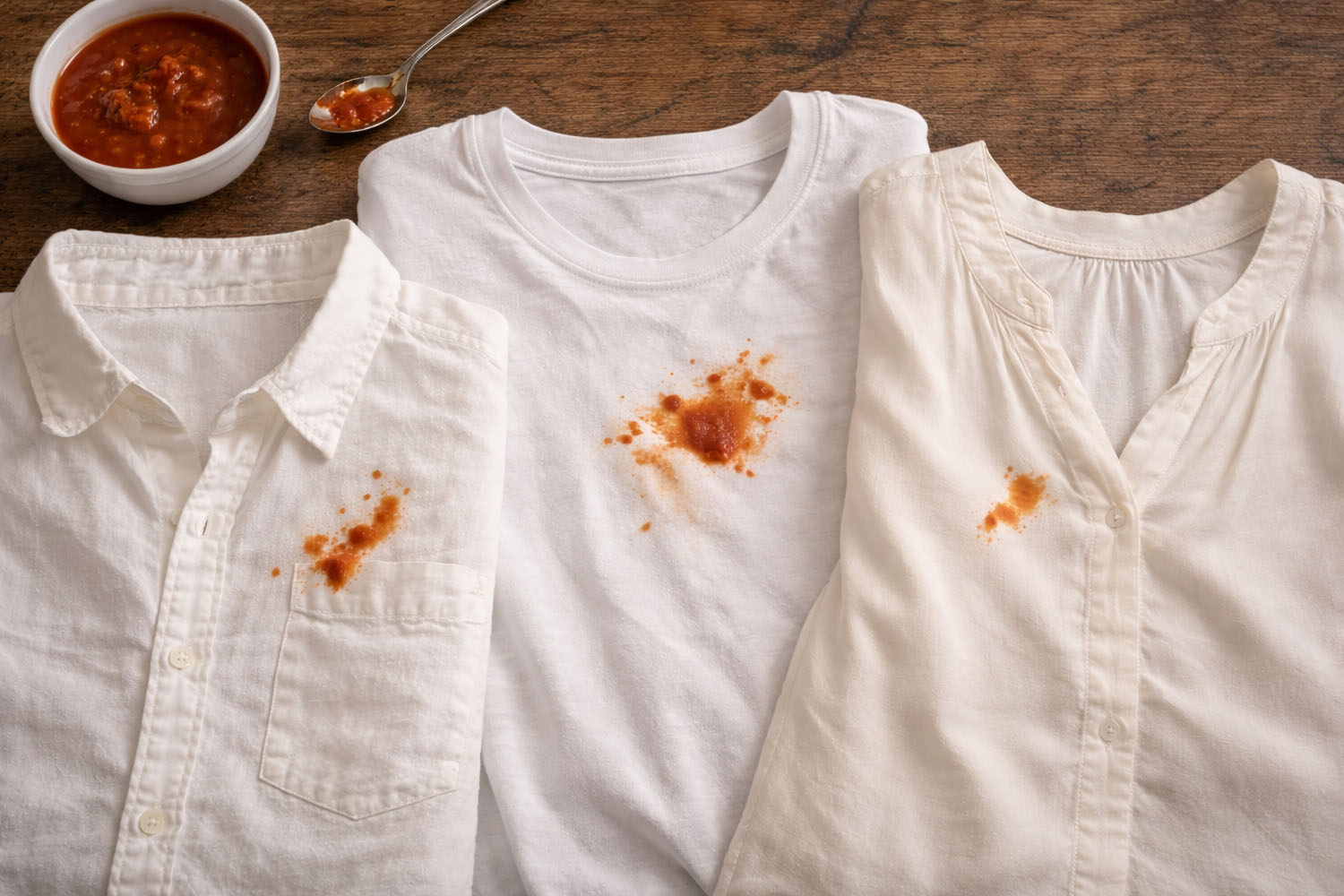
    Three white garments laid flat on a dark wood surface, each with a fresh tomato sauce splatter stain: a button-down dress shirt on the left with a stain on the breast pocket, a crew-neck t-shirt in the center with a larger splattered stain on the chest, and a sleeveless blouse on the right with a smaller stain near the neckline. In the upper left corner, a white ceramic bowl of tomato sauce and a silver spoon with sauce residue rest on the wood surface.Three white garments laid flat on a dark wood surface, each with a fresh tomato sauce splatter stain: a button-down dress shirt on the left with a stain on the breast pocket, a crew-neck t-shirt in the center with a larger splattered stain on the chest, and a sleeveless blouse on the right with a smaller stain near the neckline. In the upper left corner, a white ceramic bowl of tomato sauce and a silver spoon with sauce residue rest on the wood surface.

    1

    Method 1: Cold Water and Dish Soap Alone (The Baseline)

    This is the most instinctive approach. Grab the dish soap, add cold water, work it in. And it isn’t useless. Dish soap is a degreaser, and since tomato sauce contains oil, it has a real job to do here.

    Apply dish soap (blue Dawn is my go-to, same as the red wine method) directly to the stain. Work it in gently with your fingers in a circular motion. Let it sit 5 minutes, then rinse with cold water.

    My results: This cleared most of the greasy oil component, but the red lycopene pigment was still obviously there. The shirt looked cleaner but had a clear orange-red mark. About 50% improvement on a fresh stain.

    Verdict: Not sufficient on its own, but it’s the right first step before applying anything else. Always start here.

    2

    Method 2: Baking Soda Paste (Overhyped)

    This one gets recommended constantly online. The idea is that baking soda’s alkalinity neutralizes the tomato acidity and draws the pigment out as it dries.

    Make a thick paste with baking soda and a small amount of water, apply to the stain, let it dry completely (about 30 minutes), brush it off, then rinse.

    My results: Honestly disappointing. It didn’t do much beyond what dish soap alone had already accomplished. Messy, time-consuming, and the result was about the same as Method 1.

    Verdict: Skip this for clothing. It works better on carpet and upholstery where liquids aren’t practical. On fabric, the vinegar soak below beats it every time.

    3

    Method 3: White Vinegar Soak (Solid for Colors)

    After the dish soap pre-treatment, mix one part white vinegar with two parts cold water and soak the stained area for 20 to 30 minutes. Then launder as normal in cold water.

    It sounds counterintuitive to add more acid to an acid-based stain, but white vinegar helps break the bond between the lycopene and the fabric fiber, loosening the pigment’s grip without damaging color.

    My results: A significant step up from dish soap alone. About 75% of the fresh stain lifted. The orange tint was much fainter but still visible on close inspection. The vinegar smell washed out completely.

    Verdict: The go-to for colored fabrics where hydrogen peroxide isn’t an option. More than enough for most light, fresh stains.

    4

    Method 4: OxiClean or Enzyme Stain Remover (Best for Colors)

    Oxygen-based cleaners like OxiClean release oxygen ions that break apart the chemical bonds holding the stain to fabric. Enzyme-based removers (Spray ‘n Wash, Zout) target the organic compounds in the sauce directly. Both handle the layered nature of tomato stains better than anything else in the colored-fabric category.

    For OxiClean: mix one scoop with warm water per package directions, submerge the stained area, and soak for 1 to 6 hours. For enzyme sprays, apply directly, work it in, and let sit at least 10 minutes before washing.

    My results: The best result I got for colored fabrics. A fresh stain soaked two hours in OxiClean came out essentially perfect. Even a four-hour-old stain came out clean after a longer soak. The enzyme spray was equally effective on fresh stains.

    Verdict: The best choice for anything colored. Especially effective when the sauce is oil-heavy (pasta sauce, marinara). Worth keeping in your laundry kit.

    ⚠ Important: Do Not Mix OxiClean and Vinegar: If you’re using OxiClean, don’t use white vinegar in the same treatment session. OxiClean breaks down into hydrogen peroxide when it contacts water. Combining hydrogen peroxide with vinegar creates peracetic acid, which can irritate skin and eyes and may damage fabric fibers over time. Use one or the other per session, not both. If you want to try vinegar after an OxiClean soak, rinse the garment completely first, then launder, and treat with vinegar only if the stain persists in a separate session.

    5

    Method 5: Hydrogen Peroxide + Dish Soap (The Winner, White Fabrics Only)

    Just like with red wine, this combination won the test. Hydrogen peroxide is a mild oxidizer that breaks down the lycopene pigment at the molecular level, while the dish soap handles the oil component at the same time.

    Important: Only use this on white or very light-colored fabrics. Hydrogen peroxide has a bleaching effect and can permanently lighten or spot colored clothing.

    Here’s exactly how I do it:

    1. Mix 3 parts hydrogen peroxide (standard 3% drugstore grade) to 1 part blue Dawn dish soap.
    2. Pour the mixture directly onto the stain, fully saturating it.
    3. Let it sit for 20 to 30 minutes. You’ll see the stain begin to lighten almost immediately. That’s the peroxide reacting with the lycopene.
    4. Rinse thoroughly with cold water from the back of the stain.
    5. Check before washing. If still visible, repeat once more.
    6. Launder in cold water and air dry. Never put it in the dryer until the stain is completely gone.

    My results: The fresh stain was completely undetectable after one treatment. I genuinely could not find where it had been. A shirt left four hours before treating came out clean after two applications.

    Verdict: This is now my go-to for anything white. Cheap, uses stuff already under your sink, and genuinely impressive results.

    Pro Tip for Tough Stains: For particularly stubborn stains on white fabrics, oxygen bleach powder is a strong option, much gentler than chlorine bleach while still effective at lifting deep stains. And if you have an enzyme-based stain remover on hand, use it after the initial treatment and give it time to work before washing. Enzyme cleaners are specifically designed to break down the organic compounds in food stains.

    How to Get Dried Tomato Sauce Out of Clothes

    Dried stains are harder but not hopeless. The key difference is that you need to rehydrate the stain before treating it. Applying solutions to completely dry, crusted sauce is like trying to dissolve concrete.

    Step 1: Scrape off any dried crust with a spoon or butter knife. Don’t skip this.
    Step 2: Soak the stained area in cold water for 10 to 15 minutes to rehydrate.
    Step 3: Apply your chosen treatment (hydrogen peroxide mix for white, OxiClean or vinegar for colors).
    Step 4: Extend your soak time to 45 to 60 minutes instead of the usual 20 to 30.
    Step 5: Be prepared to repeat two to three times for stubborn, set-in stains.

    For stains that have been sitting a day or more, I had the best results doing a first pass with dish soap and cold water to loosen things up, letting it air dry, then going back in with the hydrogen peroxide treatment for white fabrics or an OxiClean soak for colors.

    What If It Already Went Through the Dryer?

    This is the question almost nobody answers well, and the most frustrating situation to be in. You washed the shirt, the stain was not fully gone, you threw it in the dryer anyway, and now the heat has essentially baked the pigment into the fabric.

    The honest truth: heat-set stains are much harder to remove, with no guarantee. But here’s what has worked for me:

    Step 1: Apply liquid dish soap to the stain and work it in firmly (you can be more aggressive with a dried, heat-set stain). Let it sit 15 minutes.

    Step 2: Mix OxiClean with warm water and soak the entire garment for 6 to 8 hours or overnight. This gives the oxygen ions maximum time to break down the set stain.

    Step 3: After the soak, apply the hydrogen peroxide and dish soap mixture directly. This second round of oxidation often breaks through what the OxiClean loosened.

    Step 4: Never back in the dryer until the stain is definitively gone. For heat-set stains, expect two to four treatment rounds.

    I’ve successfully removed heat-set tomato stains this way about 70% of the time. The remaining cases, typically old stains on silk or linen where the fibers had really absorbed the pigment, may need a professional cleaner with commercial-grade oxidizers.

    Tomato Sauce on White Clothes: One Extra Step

    White clothes are both the easiest and the most nerve-wracking scenario. Easiest because you can use hydrogen peroxide without worrying about bleaching. Hardest because any remaining orange tinge is brutally visible.

    For white fabrics, I add one step after washing: sunlight.

    If there’s still a faint ghost stain after laundering, hang the garment in direct sunlight while still damp. UV light acts as a natural bleaching agent and is remarkably effective at eliminating residual tomato pigment. Leave it two to four hours in strong sun.

    This trick has saved two shirts I thought were genuinely ruined. It only works while the fabric is still damp. The stain needs to be wet for UV activation to do its thing.

    How to Remove Tomato Stains by Fabric Type

    The method matters, but so does what you’re working with. Here’s what I found works best per fabric:

    Cotton and cotton blends: The most forgiving. Handles hydrogen peroxide, OxiClean, and vinegar soaks equally well. Multiple wash cycles won’t cause damage, so you can treat aggressively.

    Jeans and denim: Denim’s tight weave actually helps here — the sauce tends to sit on the surface rather than penetrating deeply. Dish soap and cold water first, then a vinegar soak. Avoid hot water, which can fade denim unevenly.

    Linen: Tricky because its open weave allows stains to penetrate quickly and set fast. Act immediately, be patient, expect to repeat. Extended OxiClean soaks (four to six hours) work best for colored linen; hydrogen peroxide mix for white linen.

    Polyester and synthetics: Synthetic fibers don’t absorb liquid as readily as natural ones, so the sauce tends to sit on the surface longer. Dish soap alone often handles fresh stains on polyester. Add a vinegar soak for anything stubborn.

    Silk: Avoid hydrogen peroxide entirely, as it can permanently damage silk fibers. Skip vigorous scrubbing too. Blot as much as possible, then take it to a dry cleaner. If treating at home: cold water with a small amount of gentle detergent (like Woolite), soak no more than 5 minutes, rinse very gently.

    Wool and cashmere: Hand wash only in cold water with a specialty wool detergent. No agitation that could cause felting. For anything valuable, professional cleaning is the safest call. Never put wool in the dryer.

    Pasta Sauce, Pizza Sauce, Marinara, Ketchup: Does the Type Matter?

    The stain is fundamentally the same, but oil content varies, and that changes how aggressive you need to be with the degreasing step.

    • Marinara and pasta sauces: Most oil-heavy. Start with dish soap before any other treatment to tackle the grease layer first.
    • Pizza sauce: Often thicker and more concentrated, which means it can penetrate deeply if not scraped quickly. Treat the same as marinara.
    • Ketchup: Lower in oil but high in sugar, which makes the stain sticky and potentially darker if heated. The vinegar soak works particularly well for ketchup. Act fast because the sugar content means it sets quickly.
    • Canned crushed tomato (no oil): Actually the easiest, since you’re only dealing with lycopene and not an oil layer. The vinegar soak alone often handles this completely.

    What Definitely Doesn’t Work

    Warning: Never Do These Things: According to Consumer Reports and the American Cleaning Institute, these common “solutions” make tomato stains worse or permanent:

    • Hot water: Heat sets the stain into the fabric permanently. Always use cold water.
    • Rubbing the stain: Spreads it sideways and pushes it deeper into the weave. Blot and scrape only.
    • Dryer before the stain is gone: Dryer heat permanently locks in any residual pigment. Inspect carefully in good light before drying.
    • Chlorine bleach on colors: Will remove the stain and your garment’s color along with it. Use oxygen bleach (OxiClean) instead.
    • Toothpaste: Gets recommended online frequently. Works no better than dish soap and is harder to rinse out completely.

    My Step-by-Step Emergency Protocol

    Based on everything I tested, here’s exactly what I do now. I keep a version of this on a notecard inside my laundry room cabinet.

    Step 1: Scrape off excess sauce with a spoon or card edge. Don’t rub. If you’re away from home, blot carefully with a napkin without spreading.

    Step 2: Run cold water through the back of the stain. This is the single most important physical action you can take.

    Step 3: Apply blue Dawn directly to the stain, work in gently with fingertips for one to two minutes. This tackles the oil component. Rinse.

    Step 4: White fabric gets the hydrogen peroxide and dish soap mixture, left to sit 20 to 30 minutes. Colored fabric gets a vinegar soak or enzyme spray, also left to sit 20 to 30 minutes.

    Step 5: Wash in cold water with your regular detergent.

    Step 6: Check the stain in good light with the fabric stretched flat. Any trace remaining? Repeat Steps 4 and 5 before it goes anywhere near the dryer.

    The Stain-Fighting Kit Worth Putting Together

    After my red wine stain testing, I put together a small container in my laundry room with everything I need. The tomato sauce experience confirmed the same kit handles both, along with pretty much every other food stain.

    • Hydrogen peroxide (3%, standard drugstore bottle)
    • Blue Dawn dish soap (small bottle)
    • White vinegar (in a spray bottle for easy application)
    • OxiClean Versatile Stain Remover (small container, for colored fabric soaks)
    • Clean white cloths or old t-shirt scraps for blotting
    • A dull-edged spatula or old credit card for scraping

    Total cost: under $15. The shirts it saves make it worth every penny. And if you’re interested in keeping your whole home clean with natural, non-toxic solutions, this kit is a perfect starting point.

    Frequently Asked Questions

    Does tomato sauce stain permanently?
    Not if you treat it quickly. Fresh tomato sauce stains are very removable. If you let the stain dry and set, especially through a hot dryer, the lycopene can bond permanently to fabric fibers. Even many older stains can be significantly reduced or eliminated with persistent treatment.

    Can I get tomato sauce out after washing?
    Yes, as long as it hasn’t been through the dryer. If you washed it but the stain is still there, treat it again before rewashing. Once it’s been through the dryer, you’re dealing with a heat-set stain (see above), which requires more aggressive treatment but is often still removable.

    Why does tomato sauce leave an orange mark after washing?
    That orange ring is residual lycopene, the fat-soluble pigment in tomatoes. Regular washing alone won’t remove it. You need hydrogen peroxide for white fabrics, an enzyme stain remover, or OxiClean to target that specific pigment. The vinegar soak also helps break it down.

    Does hot water help remove tomato stains?
    No. Hot water is one of the worst things you can use. Heat sets stains by causing pigments to bond more tightly to fabric fibers. Always use cold water, from treatment through laundering.

    Is the treatment the same for spaghetti sauce and pizza sauce?
    Essentially yes. All tomato-based sauces contain lycopene and oil, so the approach is the same. Sauces with higher oil content, which includes most pasta sauces, benefit from an extra dish soap pre-treatment to address the grease layer first. Pizza sauce is thicker, so scraping before treatment is especially important.

    Final Thoughts

    Tomato sauce stains feel catastrophic in the moment. But with the right approach, scraping first, cold water always, dish soap for the oil, hydrogen peroxide or OxiClean for the pigment, almost every fresh stain is fully recoverable.

    The two biggest lessons from testing: time matters more than anything else, and the dryer is your enemy until the stain is completely gone. White fabrics are actually easier to treat than colored ones once you’re willing to use hydrogen peroxide.

    Keep that stain kit stocked. It takes five minutes to put together and will save you a shirt or two every year.

    Have a method that worked, or a stain that stumped everything? Drop it in the comments. I’m always looking to update this guide.

    The post How to Get Tomato Sauce Out of Clothes: What Actually Works appeared first on Better Living.

  • 20 Useful Ways To Reuse Coffee Grounds

    ☕ What Can You Do With Used Coffee Grounds?

    Used coffee grounds are packed with nitrogen, caffeine, antioxidants, and natural oils — and most people throw them straight in the bin. Don’t. They can be used as a body scrub, natural deodorizer, dry rub for meat, garden compost ingredient, furniture scratch repair, and much more. Most uses cost absolutely nothing.

    ⚡ Start tonight: Set a small bowl of dried grounds in your fridge. They absorb odors just like baking soda — and you already have them.

    There’s nothing quite like a fresh cup of coffee at home. But if you brew every day, you’re also quietly generating one of the most underrated household resources around: used coffee grounds.

    Most of us toss them without a second thought. That’s a genuine waste. Spent grounds retain significant amounts of nitrogen, caffeine, chlorogenic acids, and natural oils from the bean — compounds with real utility in the garden, bathroom, kitchen, and beyond.

    We’ve gone through the research, checked the science, and cut through the myths to bring you 20 practical ways to put them to work.


    💆 Beauty & Skincare Uses for Coffee Grounds

    Research confirms that spent coffee grounds contain caffeine, chlorogenic acids, and natural oils — all with documented benefits for skin when applied topically.

    1

    ✨ DIY Body Scrub and Exfoliant

    Coffee grounds don’t dissolve in water, making them a natural physical exfoliant. The gritty texture buffs away dead skin cells without the synthetic microplastics found in many commercial scrubs. A 2023 review in the journal Cosmetics (MDPI) confirmed that both caffeine and chlorogenic acids in spent grounds have documented antioxidant, anti-aging, and photoprotective properties when applied topically. A 2016 study in Photochemical & Photobiological Sciences found that topical application of spent coffee ground extracts reduced UVB-induced wrinkle formation in mice by over 35% and suppressed collagen breakdown. The bioactive compounds responsible are well-established in the cosmetic science literature.

    🍽 How to use it: Mix 2 tablespoons of used grounds with 1 tablespoon of coconut oil or plain yogurt. Massage onto damp skin in circular motions for 60 seconds, then rinse with warm water. Use 1–2 times a week. Note: grounds can be too coarse for sensitive facial skin — test a small patch first.

    2

    👁 Reduce Under-Eye Puffiness

    Caffeine is a vasoconstrictor — it temporarily narrows blood vessels — which is why it’s a staple ingredient in commercial eye creams and depuffing skincare. Applied around the eyes, it may reduce puffiness and dark circles by improving microcirculation. The Cosmetics (2023) review reported that a 3% caffeine pad applied around the eyes over four weeks produced measurable improvements in skin elasticity, hydration, and pigmentation in study participants.

    🍽 How to use it: Mix a small amount of very finely ground used coffee with cooled brewed coffee or aloe vera gel. Dab gently under the eyes with a cotton pad, leave 10 minutes, then rinse with cool water. Never get grounds directly in your eyes.

    3

    🦵 Anti-Cellulite Scrub

    Caffeine’s lipolytic action — its ability to stimulate fat-metabolizing enzymes — is one of the primary reasons it appears in nearly every commercial anti-cellulite product. The same 2023 Cosmetics review specifically listed caffeine’s “lipolytic action in cellulitis” as a key documented application. The physical scrubbing further boosts local blood circulation. Effects are temporary and need consistent maintenance, but the underlying mechanism is real and well-documented in the literature.

    🍽 How to use it: Combine used grounds with a small amount of olive oil. Apply to thighs and affected areas using firm circular motions for 2–3 minutes before showering. Rinse thoroughly. A few times a week yields the best results.

    4

    💇 Scalp Scrub and Hair Treatment

    Coffee grounds exfoliate the scalp just as effectively as they exfoliate skin, removing product buildup and dead cells that weigh hair down. Caffeine has been studied for hair follicle stimulation — a 2007 study in the International Journal of Dermatology found it penetrated the hair follicle and counteracted testosterone-related suppression of follicle activity in vitro. The 2023 Cosmetics review listed “hair regrowth” among caffeine’s documented cosmetic applications.

    🍽 How to use it: Before shampooing, work a palmful of damp used grounds into your scalp with your fingertips for 60 seconds. Rinse thoroughly, then shampoo as usual. Use once a week maximum — overuse can dry out the scalp. Works especially well for oily scalps or heavy product buildup.

    5

    🤲 Remove Stubborn Cooking Odors From Your Hands

    Garlic, fish, and onion leave sulfur-based odor compounds on skin that basic hand soap alone struggles to cut. Coffee grounds act as both a natural abrasive (lifting residue) and an odor binder — their porous structure adsorbs odor molecules the same way activated charcoal does. It’s the exact same principle used in commercial “stainless steel soap” bars.

    🍽 How to use it: After chopping garlic or handling fish, rub a small amount of used grounds between your palms for 30 seconds, then rinse and follow with soap. Works best while the odor is still fresh. Keep a small jar of dried grounds next to the kitchen sink — it’s the kind of trick you’ll use every week.

    🏠 Using Coffee Grounds Around the House

    The abrasive texture, odor-absorbing properties, and natural pigment of coffee grounds make them surprisingly useful around the home.

    6

    🧼 Natural Kitchen Scrub

    The same gritty texture that makes grounds work on skin works just as well on greasy pans and baked-on kitchen grime. They’re abrasive enough to cut through grease without scratching most cookware, and completely free of the harsh chemicals in commercial scrubs.

    🍽 How to use it: Sprinkle a small amount of used grounds onto a damp cloth or sponge and scrub greasy pans or surfaces, then rinse well. Avoid stainless steel sinks — grounds leave brown staining. Also skip porous grout or unsealed stone. And never put grounds down a drain — they accumulate and cause clogs. See more chemical-free cleaning ideas in our DIY Natural Non-Toxic Cleaning Recipes.

    7

    🌬 Natural Odor Absorber

    Coffee grounds absorb odors through their porous structure and natural compounds that bind volatile odor molecules — the same principle behind activated charcoal. They work in the fridge, freezer, bathroom, shoes, gym bags, and cars. The key step most people miss: dry the grounds completely first. Wet grounds will go moldy within days and create a worse problem than the odor you’re trying to fix.

    🍽 How to use it: Spread used grounds on a baking sheet and air-dry for 24–48 hours at room temperature, or dry in a low oven (200°F / 93°C) for 20 minutes. Once fully dry, place in a small open bowl in the fridge, or fill a breathable sachet or old sock for shoes and bags. Replace every 2–3 weeks when the coffee scent fades.

    8

    🪵 Conceal Minor Scratches on Dark Wood Furniture

    Coffee grounds mixed with a small amount of water form a rich brown paste that deposits natural pigment into surface scratches on dark wood. The oils in the grounds condition the surrounding wood at the same time — which is why this tends to look more natural than marker touch-ups for minor dings and surface marks.

    🍽 How to use it: Mix grounds with just enough water to make a thick paste. Rub into the scratch with a cotton swab, leave 5–10 minutes, then wipe away excess. Repeat for deeper scratches. Always test on a hidden area first — this works best on medium to dark wood and can noticeably darken lighter finishes.

    9

    🪣 Tame Dusty Fireplace Ash When Cleaning

    Cleaning fireplace ash is notoriously messy — the particles are so fine and light that the smallest movement sends them billowing through the room. Scattering damp coffee grounds over the ash before you start binds the fine particles together and weighs them down, making the entire job dramatically less dusty and easier to contain.

    🍽 How to use it: Scatter damp (not soaking) used grounds evenly over the ash and let them sit for a minute before scooping. Remove the bound mixture with a fireplace shovel as usual. The result is far easier to bag and dispose of cleanly.

    10

    🎨 Natural Dye for Paper, Fabric, and Art Projects

    Strong brewed coffee and used grounds stain paper, fabric, and untreated wood a warm sepia-brown — the same effect you see in vintage documents and aged craft projects. The color is not colorfast on fabric (it will fade with washing), but for paper crafts, aged journaling paper, gift wrapping, and mixed-media art it creates a beautiful, completely free natural dye.

    🍽 How to use it: For paper: brew a very strong cup using extra grounds, let it cool, then brush or pour over paper and let dry flat. Repeat for deeper color. For fabric: simmer grounds in water for 30 minutes, strain, soak pre-wetted fabric in the dye bath. For art: mix dry grounds into paint for earthy texture or press into damp clay.

    11

    🐾 Neutralize Pet Accident Odors on Hard Floors

    After cleaning a pet accident on a hard floor, residual odor molecules can linger in the surface. Dried coffee grounds placed briefly over the cleaned area can adsorb those remaining compounds — acting similarly to baking soda — before a final wipe-down.

    ⚠ Safety warning: Coffee grounds are toxic to dogs and cats if ingested. Even small amounts can cause caffeine poisoning. Only use on hard floors you can wipe completely clean immediately before pets access the area. Never use on carpets or anywhere a pet can sniff or lick. If your pet ingests coffee grounds, contact your vet or ASPCA Animal Poison Control immediately.

    🌱 Using Coffee Grounds in the Garden

    📢 A note on garden myths: A lot of popular advice overstates what coffee grounds can do in the garden. The most rigorous science on this topic comes from Dr. Linda Chalker-Scott’s WSU Extension Fact Sheet (FS207E) — peer-reviewed research we reference throughout this section. Her findings are more conservative than most gardening blogs, and more accurate.

    12

    🌿 Add to Your Compost Pile

    Composting is the single best and most evidence-backed use for coffee grounds in the garden. Grounds are nitrogen-rich — proteins make up over 10% of their content by weight — classifying them as a “green” material that feeds microorganisms and accelerates decomposition. According to Dr. Chalker-Scott’s WSU Extension research, properly composted grounds provide nitrogen, phosphorus, iron, and zinc to the finished soil. They also bind pesticide residues and heavy metals like cadmium, preventing their movement into surrounding plants and environment.

    ⚠ Two important caveats: First, fresh unbrewed grounds are phytotoxic — multiple peer-reviewed studies confirm they inhibit plant growth. Always use spent grounds from brewing. Second, thick layers of grounds compact into a water-repellent crust (per WSU research) that harms plants. Never use as thick stand-alone mulch.
    🍽 How to use it: Add used grounds to your compost bin daily as a green (nitrogen) material. Balance with brown materials — dried leaves, shredded newspaper, cardboard, wood chips, or straw. Aim for grounds to be no more than roughly 20% of total compost volume.

    13

    🐛 Feed Earthworms and Improve Soil Structure

    One of the best-documented benefits of coffee grounds in the garden is earthworm activity. WSU Extension’s FS207E cites research showing that earthworms are voracious consumers of coffee grounds, pulling them deeper into soil — which directly improves soil structure through increased aggregation. As grounds break down, they also produce humic substances that are important chemical and structural components of healthy soil. Additionally, Dr. Chalker-Scott’s research confirms that coffee grounds increase the availability of essential plant nutrients — nitrogen, phosphorus, iron, and zinc — particularly in more alkaline soils.

    ⚠ A note on pest control claims: You may have read that coffee grounds repel slugs, ants, or cats. WSU Extension’s peer-reviewed fact sheet explicitly states there is currently no published scientific evidence that grounds repel or kill any garden pests. Treat that claim with skepticism — the composting and earthworm benefits are the real, evidence-backed story.
    🍽 How to use it: Work used grounds lightly into the top inch of garden soil around plants, or add them to a worm composting bin. Worm bins thrive with a small addition of grounds weekly — but don’t overdo it, as high concentrations can affect worm health. Aim for grounds to be one ingredient among many.

    14

    🦟 Discourage Mosquito Breeding in Standing Water

    A 2015 study published in Parasites and Vectors found that female mosquitoes avoided laying eggs in water treated with coffee grounds, and that hatching rates were significantly lower when they did. This is a legitimate, research-backed use — with one important clarification.

    ⚠ Be precise about what this does: The research confirms grounds deter mosquito egg-laying in standing water. There is currently no peer-reviewed evidence that coffee grounds repel adult mosquitoes from biting people — despite what many viral posts claim.
    🍽 How to use it: Add a tablespoon of used grounds to birdbaths, drainage saucers, or decorative containers in your yard to discourage mosquitoes from using those spots as breeding grounds. Replace weekly or after rain.

    15

    🍄 Grow Oyster Mushrooms at Home

    Spent coffee grounds are one of the best substrates for growing oyster mushrooms at home — and this is backed by solid mycological research. A study published in Acta Biotechnologica confirmed that spent coffee grounds support good yields of Pleurotus ostreatus (oyster mushrooms) in solid-state fermentation. Grounds are already partially sterilized by the brewing process, nutritionally dense, and at the right moisture level for mycelium. You can grow a full harvest in a used takeaway container on a kitchen counter.

    🍽 How to use it: Collect grounds daily in a sealed container in the fridge to prevent mold. Once you have 1–2 lbs, mix with oyster mushroom spawn (available from online suppliers). Pack into a container with small air holes, keep in a cool shaded spot, and mist twice daily. Expect fruiting in 2–3 weeks. Then use them in our Gluten-Free Stuffed Mushrooms recipe!

    🍳 Using Coffee Grounds in the Kitchen

    Coffee’s bitter, roasted depth is one of the most underused flavor enhancers in home cooking. If you haven’t tried cooking with grounds yet, start here.

    16

    🥩 Dry Rub for Ribs, Steak, and Chicken

    Coffee is a genuinely excellent addition to dry rubs. Its slightly bitter, roasted depth pairs beautifully with smoky, spiced flavors, and its mild acidity works as a natural meat tenderizer. If you’ve enjoyed a coffee-rubbed brisket at a BBQ restaurant, now you know how to do it at home.

    🍽 Recipe starter: Combine 2 tbsp finely ground used coffee, 1 tbsp brown sugar, 1 tbsp smoked paprika, 1 tsp each of garlic powder, onion powder, black pepper, and salt, and a pinch of cayenne. Rub generously over the meat and refrigerate at least 30 minutes before cooking. Try it on our Easy Cajun-Style BBQ Ribs — the coffee rub pairs brilliantly with Cajun seasoning.

    17

    ☕ Add Depth to BBQ Sauce

    Coffee deepens the complexity of BBQ sauce the same way it deepens chocolate — amplifying and rounding existing flavors without making anything taste like a latte. The bitterness balances sweetness beautifully, and the roasted notes add a smoky dimension that’s hard to achieve any other way.

    🍽 How to use it: Stir 3–4 tablespoons of finely ground used coffee into ⅓ cup of your favorite BBQ sauce. Let sit for 20 minutes so the grounds steep and infuse, then baste onto ribs or chicken. Works brilliantly with our Easy Cajun-Style BBQ Ribs. Start with less and build to taste.

    18

    🍫 Intensify Chocolate Flavor in Baked Goods

    A small amount of finely ground coffee in baking doesn’t make things taste like coffee — it makes chocolate taste more chocolatey. The bitter, roasted compounds in coffee interact with cocoa’s flavor compounds to deepen and round them. It’s one of the oldest professional baking tricks, and it works whether you use espresso powder or finely ground used coffee.

    • Brownies and chocolate cake: Add 1–2 teaspoons to the dry ingredients. The difference in depth is noticeable.
    • Mocha cookies and oatmeal cookies: A teaspoon adds a subtle roasted complexity that elevates the whole cookie.
    • Chocolate frosting or ganache: Steep a teaspoon of grounds in warm cream for 5 minutes, then strain and use as usual.
    ⚠ Grind size matters: Only use finely ground used coffee in baking. Coarse grounds (from a French press or percolator) create an unpleasant gritty texture. Pulse briefly in a spice grinder before adding to any recipe.

    19

    🍝 Substitute for Instant Coffee or Espresso Powder in Recipes

    Many recipes call for instant coffee or espresso powder — things most home cooks don’t keep stocked. Finely ground used coffee is a direct substitute in most cooking applications. The flavor will be slightly less concentrated than instant espresso powder, so use a touch more and adjust to taste.

    🍽 Works well in: Tiramisu, mocha frosting, coffee-flavored whipped cream, chocolate sauces, glazes, and marinades for beef. For liquid-based applications — tiramisu, cocktails — brewed coffee from the same used grounds works even better than the dry grounds themselves.

    📦 How to Store Used Coffee Grounds (So They Don’t Go Moldy)

    20

    The Right Storage Approach for Every Use

    Wet grounds go moldy within 2–3 days at room temperature. The right storage method depends entirely on what you plan to use them for:

    • For immediate use — scrubs, cooking, scalp treatment: Use grounds from today’s or yesterday’s brew. Store in an open container in the fridge and use within 3 days.
    • For deodorizing (fridge, shoes, bags): Dry completely first. Spread on a baking sheet at room temperature for 24–48 hours, or bake at 200°F / 93°C for 20 minutes. Store in a sealed jar once dry — keeps for several weeks.
    • For composting: Add to the bin daily. Worms and microorganisms love moist grounds — no drying needed.
    • For mushroom growing: Refrigerate in a sealed container and use within 4–5 days before mold sets in.
    💡 Pro tip: Keep a small open jar next to your coffee maker. Add each day’s grounds loosely — don’t seal it tightly. A loose cover lets moisture escape and slows molding. Check every 3 days; if you see mold, discard and start fresh.

    ❓ Frequently Asked Questions About Coffee Grounds

    Are coffee grounds acidic? Will they lower my soil’s pH?

    This is the single most widespread myth about coffee grounds in the garden — and it is not accurate. Coffee is acidic, but the acids are water-soluble and mostly end up in your brewed cup, not the grounds. WSU Extension’s research by Dr. Chalker-Scott documented studies finding pH levels in used grounds ranging from mildly acidic to nearly alkaline, and notes the pH continues to shift as grounds decompose. Do not rely on them to acidify soil for plants like blueberries — get a proper soil test instead.

    Are coffee grounds safe for pets?

    No. Coffee grounds contain caffeine, which is toxic to both dogs and cats. Even small amounts can cause restlessness, rapid breathing, tremors, and in more severe cases, dangerous cardiac effects. Keep all uses well out of reach of pets. If your pet ingests coffee grounds, contact your vet or ASPCA Animal Poison Control immediately.

    Do coffee grounds repel mosquitoes?

    Partially — but not in the way most people think. A 2015 study in Parasites and Vectors confirmed that grounds in standing water deter female mosquitoes from laying eggs and suppress hatching when they do. There is no peer-reviewed evidence that grounds repel adult mosquitoes from biting people. Use grounds to treat standing water in your yard — not as a personal insect repellent.

    Can you reuse coffee grounds a second time for brewing?

    For brewing, no. Used grounds have given up most of their soluble flavor compounds and will produce a weak, flat, overly bitter cup. For every other use in this article, they work perfectly well. You can also steep them a second time to make a very weak coffee concentrate that works as a natural dye or a rinse for dark hair.

    Can I put coffee grounds directly on garden soil as mulch?

    This is where most garden blogs go wrong. According to WSU Extension, applying grounds directly as a thick mulch layer is not recommended — the fine texture compacts easily, forming a hydrophobic crust that repels water and harms roots. The correct approach: always compost them first, or apply as a very thin surface layer (no more than half an inch) and cover immediately with a thicker layer of coarse organic mulch like wood chips.


    ☕ The Bottom Line

    Used coffee grounds are one of the most consistently wasted household by-products. Whether you’re treating your skin, seasoning a steak, building better compost, or growing mushrooms for dinner — there’s almost always a better place for them than the bin.

    The best way to start is to pick just one idea and try it this week. Set a bowl of dried grounds in your fridge tonight, or save tomorrow morning’s grounds for a body scrub. Once you see how well they work, finding uses becomes second nature.

    ☕ Which of these are you trying first? Drop it in the comments below — we’d love to know!

    🍽 More From Better Living You Might Love

    The post 20 Useful Ways To Reuse Coffee Grounds appeared first on Better Living.