Wishing all the ladies a very happy International Women’s Day!
Today is our day, and we make a difference in the world!


Wishing all the ladies a very happy International Women’s Day!
Today is our day, and we make a difference in the world!

Learning how to get tomato sauce out of clothes is one of those skills you pick up the hard way. Usually mid-dinner, and usually on something white.
One second I was serving spaghetti. The next, half a bowl of marinara was sliding down the front of my white linen shirt in slow motion. The shirt I’d owned for three years without a single stain.
I did what anyone would do: grabbed a napkin and made it worse.
Here’s what nobody tells you about tomato sauce stains: they’re not like other stains.
You can’t just throw them in the wash and hope for the best. Tomato sauce laughs at your washing machine. It comes out looking almost exactly the same as when it went in, sometimes darker, always more set. I know this from painful, repeated, completely avoidable experience.
So I did what I did after ruining a shirt with red wine: I got systematic about it.
I stained fresh shirts and dried shirts, tested every method I could find, ranked them honestly, and documented what actually worked.
No guesswork. No methods that sound good but don’t hold up.
Here’s the full breakdown.
Quick Answer: How to Get Tomato Sauce Out of Clothes: Scrape off the excess. Don’t rub. Flush with cold water through the back of the fabric. Apply dish soap directly to the stain and work it in gently. Soak in cold water with white vinegar for 20 to 30 minutes. For white fabrics, use a hydrogen peroxide and dish soap mixture for best results. Launder in cold water. Never put it in the dryer until the stain is completely gone.
Tomato sauce isn’t one stain. It’s three stains layered on top of each other, and each component needs a different approach to break down.
Lycopene (the red pigment): This is what gives tomatoes their deep red color. Lycopene is fat-soluble, which means water alone won’t touch it. It bonds to fabric fibers and doesn’t let go without a surfactant like dish soap or detergent to break that bond.
Oil: Most tomato sauces, including marinara, pasta sauce, and pizza sauce, are cooked in olive oil. That oil embeds itself in fabric fibers right alongside the red pigment, creating a greasy stain beneath the visible one.
Acidity: Tomatoes are naturally acidic. That acidity can actually accelerate the staining process, essentially curing the pigment into natural fibers like cotton and linen over time.
According to the American Cleaning Institute, the key to removing tomato sauce is acting fast and always flushing the stain from the back of the fabric, never the front. Understanding the triple-threat chemistry is what makes that advice actually make sense.
This is where most people go wrong immediately.
When tomato sauce lands on your shirt, the instinct is to wipe. Don’t. Wiping spreads the sauce sideways and pushes it deeper into the fabric, turning a small stain into a big one.
Instead, scrape. Use a spoon, a dull knife, or the edge of a credit card. Anything that lifts the sauce off the surface without pressing it in further. Work from the outside of the stain inward.
Then run cold water through the back of the stain, not the front. Pushing water through from behind forces the sauce back out the way it came. This one step makes everything else work better.
Time test: I stained five identical white cotton shirts and treated them at 5 minutes, 15 minutes, 1 hour, 4 hours, and 24 hours. The 5-minute shirt came out completely clean. The 24-hour shirt still had a faint orange ring after two full treatments. Act fast.
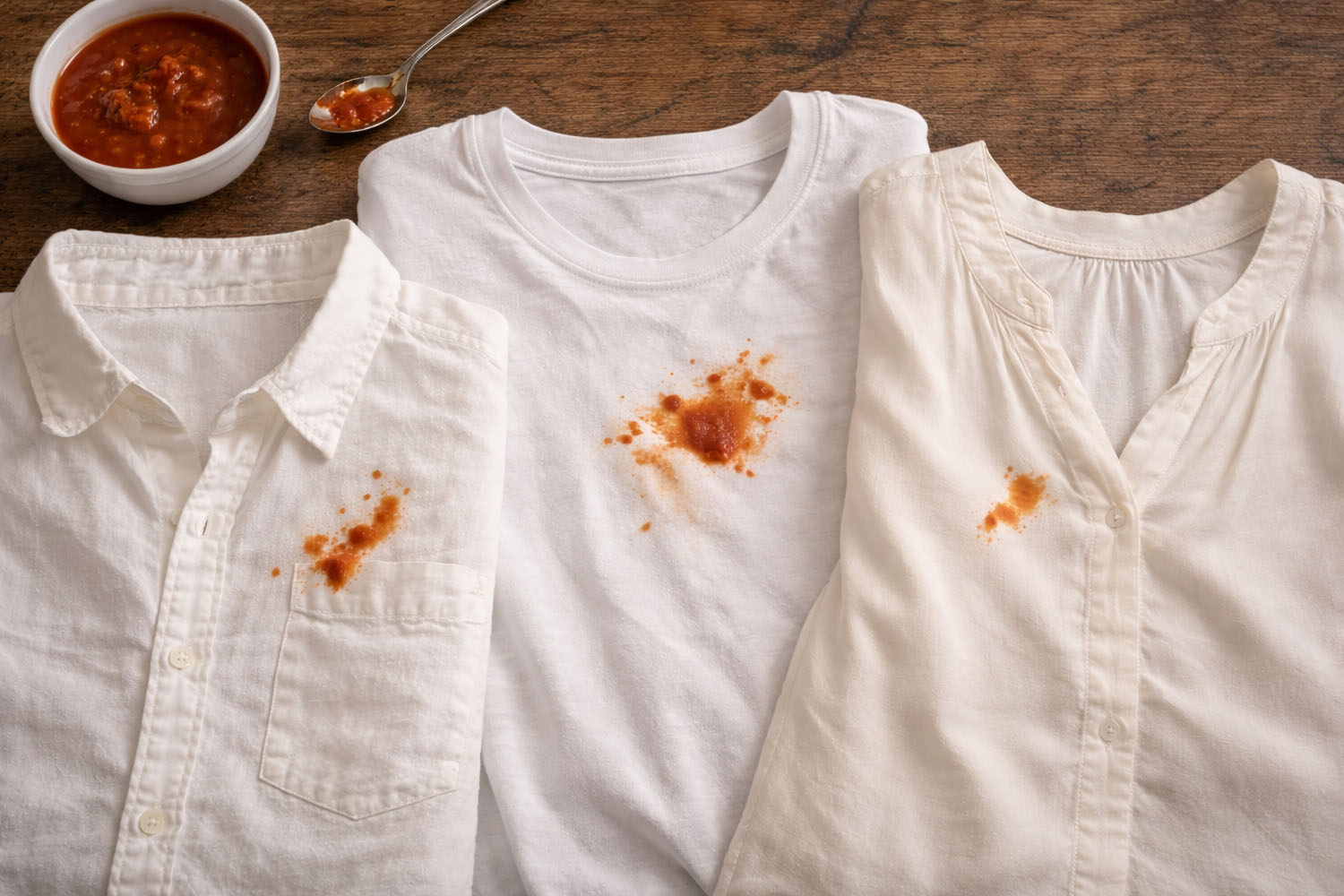
This is the most instinctive approach. Grab the dish soap, add cold water, work it in. And it isn’t useless. Dish soap is a degreaser, and since tomato sauce contains oil, it has a real job to do here.
Apply dish soap (blue Dawn is my go-to, same as the red wine method) directly to the stain. Work it in gently with your fingers in a circular motion. Let it sit 5 minutes, then rinse with cold water.
My results: This cleared most of the greasy oil component, but the red lycopene pigment was still obviously there. The shirt looked cleaner but had a clear orange-red mark. About 50% improvement on a fresh stain.
Verdict: Not sufficient on its own, but it’s the right first step before applying anything else. Always start here.
This one gets recommended constantly online. The idea is that baking soda’s alkalinity neutralizes the tomato acidity and draws the pigment out as it dries.
Make a thick paste with baking soda and a small amount of water, apply to the stain, let it dry completely (about 30 minutes), brush it off, then rinse.
My results: Honestly disappointing. It didn’t do much beyond what dish soap alone had already accomplished. Messy, time-consuming, and the result was about the same as Method 1.
Verdict: Skip this for clothing. It works better on carpet and upholstery where liquids aren’t practical. On fabric, the vinegar soak below beats it every time.
After the dish soap pre-treatment, mix one part white vinegar with two parts cold water and soak the stained area for 20 to 30 minutes. Then launder as normal in cold water.
It sounds counterintuitive to add more acid to an acid-based stain, but white vinegar helps break the bond between the lycopene and the fabric fiber, loosening the pigment’s grip without damaging color.
My results: A significant step up from dish soap alone. About 75% of the fresh stain lifted. The orange tint was much fainter but still visible on close inspection. The vinegar smell washed out completely.
Verdict: The go-to for colored fabrics where hydrogen peroxide isn’t an option. More than enough for most light, fresh stains.
Oxygen-based cleaners like OxiClean release oxygen ions that break apart the chemical bonds holding the stain to fabric. Enzyme-based removers (Spray ‘n Wash, Zout) target the organic compounds in the sauce directly. Both handle the layered nature of tomato stains better than anything else in the colored-fabric category.
For OxiClean: mix one scoop with warm water per package directions, submerge the stained area, and soak for 1 to 6 hours. For enzyme sprays, apply directly, work it in, and let sit at least 10 minutes before washing.
My results: The best result I got for colored fabrics. A fresh stain soaked two hours in OxiClean came out essentially perfect. Even a four-hour-old stain came out clean after a longer soak. The enzyme spray was equally effective on fresh stains.
Verdict: The best choice for anything colored. Especially effective when the sauce is oil-heavy (pasta sauce, marinara). Worth keeping in your laundry kit.
 Important: Do Not Mix OxiClean and Vinegar: If you’re using OxiClean, don’t use white vinegar in the same treatment session. OxiClean breaks down into hydrogen peroxide when it contacts water. Combining hydrogen peroxide with vinegar creates peracetic acid, which can irritate skin and eyes and may damage fabric fibers over time. Use one or the other per session, not both. If you want to try vinegar after an OxiClean soak, rinse the garment completely first, then launder, and treat with vinegar only if the stain persists in a separate session.
Just like with red wine, this combination won the test. Hydrogen peroxide is a mild oxidizer that breaks down the lycopene pigment at the molecular level, while the dish soap handles the oil component at the same time.
Important: Only use this on white or very light-colored fabrics. Hydrogen peroxide has a bleaching effect and can permanently lighten or spot colored clothing.
Here’s exactly how I do it:
My results: The fresh stain was completely undetectable after one treatment. I genuinely could not find where it had been. A shirt left four hours before treating came out clean after two applications.
Verdict: This is now my go-to for anything white. Cheap, uses stuff already under your sink, and genuinely impressive results.
Pro Tip for Tough Stains: For particularly stubborn stains on white fabrics, oxygen bleach powder is a strong option, much gentler than chlorine bleach while still effective at lifting deep stains. And if you have an enzyme-based stain remover on hand, use it after the initial treatment and give it time to work before washing. Enzyme cleaners are specifically designed to break down the organic compounds in food stains.
Dried stains are harder but not hopeless. The key difference is that you need to rehydrate the stain before treating it. Applying solutions to completely dry, crusted sauce is like trying to dissolve concrete.
Step 1: Scrape off any dried crust with a spoon or butter knife. Don’t skip this.
Step 2: Soak the stained area in cold water for 10 to 15 minutes to rehydrate.
Step 3: Apply your chosen treatment (hydrogen peroxide mix for white, OxiClean or vinegar for colors).
Step 4: Extend your soak time to 45 to 60 minutes instead of the usual 20 to 30.
Step 5: Be prepared to repeat two to three times for stubborn, set-in stains.
For stains that have been sitting a day or more, I had the best results doing a first pass with dish soap and cold water to loosen things up, letting it air dry, then going back in with the hydrogen peroxide treatment for white fabrics or an OxiClean soak for colors.
This is the question almost nobody answers well, and the most frustrating situation to be in. You washed the shirt, the stain was not fully gone, you threw it in the dryer anyway, and now the heat has essentially baked the pigment into the fabric.
The honest truth: heat-set stains are much harder to remove, with no guarantee. But here’s what has worked for me:
Step 1: Apply liquid dish soap to the stain and work it in firmly (you can be more aggressive with a dried, heat-set stain). Let it sit 15 minutes.
Step 2: Mix OxiClean with warm water and soak the entire garment for 6 to 8 hours or overnight. This gives the oxygen ions maximum time to break down the set stain.
Step 3: After the soak, apply the hydrogen peroxide and dish soap mixture directly. This second round of oxidation often breaks through what the OxiClean loosened.
Step 4: Never back in the dryer until the stain is definitively gone. For heat-set stains, expect two to four treatment rounds.
I’ve successfully removed heat-set tomato stains this way about 70% of the time. The remaining cases, typically old stains on silk or linen where the fibers had really absorbed the pigment, may need a professional cleaner with commercial-grade oxidizers.
White clothes are both the easiest and the most nerve-wracking scenario. Easiest because you can use hydrogen peroxide without worrying about bleaching. Hardest because any remaining orange tinge is brutally visible.
For white fabrics, I add one step after washing: sunlight.
If there’s still a faint ghost stain after laundering, hang the garment in direct sunlight while still damp. UV light acts as a natural bleaching agent and is remarkably effective at eliminating residual tomato pigment. Leave it two to four hours in strong sun.
This trick has saved two shirts I thought were genuinely ruined. It only works while the fabric is still damp. The stain needs to be wet for UV activation to do its thing.
The method matters, but so does what you’re working with. Here’s what I found works best per fabric:
Cotton and cotton blends: The most forgiving. Handles hydrogen peroxide, OxiClean, and vinegar soaks equally well. Multiple wash cycles won’t cause damage, so you can treat aggressively.
Jeans and denim: Denim’s tight weave actually helps here — the sauce tends to sit on the surface rather than penetrating deeply. Dish soap and cold water first, then a vinegar soak. Avoid hot water, which can fade denim unevenly.
Linen: Tricky because its open weave allows stains to penetrate quickly and set fast. Act immediately, be patient, expect to repeat. Extended OxiClean soaks (four to six hours) work best for colored linen; hydrogen peroxide mix for white linen.
Polyester and synthetics: Synthetic fibers don’t absorb liquid as readily as natural ones, so the sauce tends to sit on the surface longer. Dish soap alone often handles fresh stains on polyester. Add a vinegar soak for anything stubborn.
Silk: Avoid hydrogen peroxide entirely, as it can permanently damage silk fibers. Skip vigorous scrubbing too. Blot as much as possible, then take it to a dry cleaner. If treating at home: cold water with a small amount of gentle detergent (like Woolite), soak no more than 5 minutes, rinse very gently.
Wool and cashmere: Hand wash only in cold water with a specialty wool detergent. No agitation that could cause felting. For anything valuable, professional cleaning is the safest call. Never put wool in the dryer.
The stain is fundamentally the same, but oil content varies, and that changes how aggressive you need to be with the degreasing step.
Warning: Never Do These Things: According to Consumer Reports and the American Cleaning Institute, these common “solutions” make tomato stains worse or permanent:
Based on everything I tested, here’s exactly what I do now. I keep a version of this on a notecard inside my laundry room cabinet.
Step 1: Scrape off excess sauce with a spoon or card edge. Don’t rub. If you’re away from home, blot carefully with a napkin without spreading.
Step 2: Run cold water through the back of the stain. This is the single most important physical action you can take.
Step 3: Apply blue Dawn directly to the stain, work in gently with fingertips for one to two minutes. This tackles the oil component. Rinse.
Step 4: White fabric gets the hydrogen peroxide and dish soap mixture, left to sit 20 to 30 minutes. Colored fabric gets a vinegar soak or enzyme spray, also left to sit 20 to 30 minutes.
Step 5: Wash in cold water with your regular detergent.
Step 6: Check the stain in good light with the fabric stretched flat. Any trace remaining? Repeat Steps 4 and 5 before it goes anywhere near the dryer.
After my red wine stain testing, I put together a small container in my laundry room with everything I need. The tomato sauce experience confirmed the same kit handles both, along with pretty much every other food stain.
Total cost: under $15. The shirts it saves make it worth every penny. And if you’re interested in keeping your whole home clean with natural, non-toxic solutions, this kit is a perfect starting point.
Does tomato sauce stain permanently?
Not if you treat it quickly. Fresh tomato sauce stains are very removable. If you let the stain dry and set, especially through a hot dryer, the lycopene can bond permanently to fabric fibers. Even many older stains can be significantly reduced or eliminated with persistent treatment.
Can I get tomato sauce out after washing?
Yes, as long as it hasn’t been through the dryer. If you washed it but the stain is still there, treat it again before rewashing. Once it’s been through the dryer, you’re dealing with a heat-set stain (see above), which requires more aggressive treatment but is often still removable.
Why does tomato sauce leave an orange mark after washing?
That orange ring is residual lycopene, the fat-soluble pigment in tomatoes. Regular washing alone won’t remove it. You need hydrogen peroxide for white fabrics, an enzyme stain remover, or OxiClean to target that specific pigment. The vinegar soak also helps break it down.
Does hot water help remove tomato stains?
No. Hot water is one of the worst things you can use. Heat sets stains by causing pigments to bond more tightly to fabric fibers. Always use cold water, from treatment through laundering.
Is the treatment the same for spaghetti sauce and pizza sauce?
Essentially yes. All tomato-based sauces contain lycopene and oil, so the approach is the same. Sauces with higher oil content, which includes most pasta sauces, benefit from an extra dish soap pre-treatment to address the grease layer first. Pizza sauce is thicker, so scraping before treatment is especially important.
Tomato sauce stains feel catastrophic in the moment. But with the right approach, scraping first, cold water always, dish soap for the oil, hydrogen peroxide or OxiClean for the pigment, almost every fresh stain is fully recoverable.
The two biggest lessons from testing: time matters more than anything else, and the dryer is your enemy until the stain is completely gone. White fabrics are actually easier to treat than colored ones once you’re willing to use hydrogen peroxide.
Keep that stain kit stocked. It takes five minutes to put together and will save you a shirt or two every year.
Have a method that worked, or a stain that stumped everything? Drop it in the comments. I’m always looking to update this guide.
Related Cleaning Guides:
The post How to Get Tomato Sauce Out of Clothes: What Actually Works appeared first on Better Living.
 What Can You Do With Used Coffee Grounds?
Used coffee grounds are packed with nitrogen, caffeine, antioxidants, and natural oils — and most people throw them straight in the bin. Don’t. They can be used as a body scrub, natural deodorizer, dry rub for meat, garden compost ingredient, furniture scratch repair, and much more. Most uses cost absolutely nothing.
 Start tonight: Set a small bowl of dried grounds in your fridge. They absorb odors just like baking soda — and you already have them.
There’s nothing quite like a fresh cup of coffee at home. But if you brew every day, you’re also quietly generating one of the most underrated household resources around: used coffee grounds.
Most of us toss them without a second thought. That’s a genuine waste. Spent grounds retain significant amounts of nitrogen, caffeine, chlorogenic acids, and natural oils from the bean — compounds with real utility in the garden, bathroom, kitchen, and beyond.
We’ve gone through the research, checked the science, and cut through the myths to bring you 20 practical ways to put them to work.
 Jump to a Section
 Beauty & Skincare Uses for Coffee Grounds
Research confirms that spent coffee grounds contain caffeine, chlorogenic acids, and natural oils — all with documented benefits for skin when applied topically.
 DIY Body Scrub and Exfoliant
Coffee grounds don’t dissolve in water, making them a natural physical exfoliant. The gritty texture buffs away dead skin cells without the synthetic microplastics found in many commercial scrubs. A 2023 review in the journal Cosmetics (MDPI) confirmed that both caffeine and chlorogenic acids in spent grounds have documented antioxidant, anti-aging, and photoprotective properties when applied topically. A 2016 study in Photochemical & Photobiological Sciences found that topical application of spent coffee ground extracts reduced UVB-induced wrinkle formation in mice by over 35% and suppressed collagen breakdown. The bioactive compounds responsible are well-established in the cosmetic science literature.
 How to use it: Mix 2 tablespoons of used grounds with 1 tablespoon of coconut oil or plain yogurt. Massage onto damp skin in circular motions for 60 seconds, then rinse with warm water. Use 1–2 times a week. Note: grounds can be too coarse for sensitive facial skin — test a small patch first.
 Reduce Under-Eye Puffiness
Caffeine is a vasoconstrictor — it temporarily narrows blood vessels — which is why it’s a staple ingredient in commercial eye creams and depuffing skincare. Applied around the eyes, it may reduce puffiness and dark circles by improving microcirculation. The Cosmetics (2023) review reported that a 3% caffeine pad applied around the eyes over four weeks produced measurable improvements in skin elasticity, hydration, and pigmentation in study participants.
How to use it: Mix a small amount of very finely ground used coffee with cooled brewed coffee or aloe vera gel. Dab gently under the eyes with a cotton pad, leave 10 minutes, then rinse with cool water. Never get grounds directly in your eyes. Anti-Cellulite Scrub
Caffeine’s lipolytic action — its ability to stimulate fat-metabolizing enzymes — is one of the primary reasons it appears in nearly every commercial anti-cellulite product. The same 2023 Cosmetics review specifically listed caffeine’s “lipolytic action in cellulitis” as a key documented application. The physical scrubbing further boosts local blood circulation. Effects are temporary and need consistent maintenance, but the underlying mechanism is real and well-documented in the literature.
How to use it: Combine used grounds with a small amount of olive oil. Apply to thighs and affected areas using firm circular motions for 2–3 minutes before showering. Rinse thoroughly. A few times a week yields the best results. Scalp Scrub and Hair Treatment
Coffee grounds exfoliate the scalp just as effectively as they exfoliate skin, removing product buildup and dead cells that weigh hair down. Caffeine has been studied for hair follicle stimulation — a 2007 study in the International Journal of Dermatology found it penetrated the hair follicle and counteracted testosterone-related suppression of follicle activity in vitro. The 2023 Cosmetics review listed “hair regrowth” among caffeine’s documented cosmetic applications.
How to use it: Before shampooing, work a palmful of damp used grounds into your scalp with your fingertips for 60 seconds. Rinse thoroughly, then shampoo as usual. Use once a week maximum — overuse can dry out the scalp. Works especially well for oily scalps or heavy product buildup. Remove Stubborn Cooking Odors From Your Hands
Garlic, fish, and onion leave sulfur-based odor compounds on skin that basic hand soap alone struggles to cut. Coffee grounds act as both a natural abrasive (lifting residue) and an odor binder — their porous structure adsorbs odor molecules the same way activated charcoal does. It’s the exact same principle used in commercial “stainless steel soap” bars.
How to use it: After chopping garlic or handling fish, rub a small amount of used grounds between your palms for 30 seconds, then rinse and follow with soap. Works best while the odor is still fresh. Keep a small jar of dried grounds next to the kitchen sink — it’s the kind of trick you’ll use every week. Using Coffee Grounds Around the House
The abrasive texture, odor-absorbing properties, and natural pigment of coffee grounds make them surprisingly useful around the home.
 Natural Kitchen Scrub
The same gritty texture that makes grounds work on skin works just as well on greasy pans and baked-on kitchen grime. They’re abrasive enough to cut through grease without scratching most cookware, and completely free of the harsh chemicals in commercial scrubs.
How to use it: Sprinkle a small amount of used grounds onto a damp cloth or sponge and scrub greasy pans or surfaces, then rinse well. Avoid stainless steel sinks — grounds leave brown staining. Also skip porous grout or unsealed stone. And never put grounds down a drain — they accumulate and cause clogs. See more chemical-free cleaning ideas in our DIY Natural Non-Toxic Cleaning Recipes. Natural Odor Absorber
Coffee grounds absorb odors through their porous structure and natural compounds that bind volatile odor molecules — the same principle behind activated charcoal. They work in the fridge, freezer, bathroom, shoes, gym bags, and cars. The key step most people miss: dry the grounds completely first. Wet grounds will go moldy within days and create a worse problem than the odor you’re trying to fix.
How to use it: Spread used grounds on a baking sheet and air-dry for 24–48 hours at room temperature, or dry in a low oven (200°F / 93°C) for 20 minutes. Once fully dry, place in a small open bowl in the fridge, or fill a breathable sachet or old sock for shoes and bags. Replace every 2–3 weeks when the coffee scent fades. Conceal Minor Scratches on Dark Wood Furniture
Coffee grounds mixed with a small amount of water form a rich brown paste that deposits natural pigment into surface scratches on dark wood. The oils in the grounds condition the surrounding wood at the same time — which is why this tends to look more natural than marker touch-ups for minor dings and surface marks.
How to use it: Mix grounds with just enough water to make a thick paste. Rub into the scratch with a cotton swab, leave 5–10 minutes, then wipe away excess. Repeat for deeper scratches. Always test on a hidden area first — this works best on medium to dark wood and can noticeably darken lighter finishes. Tame Dusty Fireplace Ash When Cleaning
Cleaning fireplace ash is notoriously messy — the particles are so fine and light that the smallest movement sends them billowing through the room. Scattering damp coffee grounds over the ash before you start binds the fine particles together and weighs them down, making the entire job dramatically less dusty and easier to contain.
How to use it: Scatter damp (not soaking) used grounds evenly over the ash and let them sit for a minute before scooping. Remove the bound mixture with a fireplace shovel as usual. The result is far easier to bag and dispose of cleanly. Natural Dye for Paper, Fabric, and Art Projects
Strong brewed coffee and used grounds stain paper, fabric, and untreated wood a warm sepia-brown — the same effect you see in vintage documents and aged craft projects. The color is not colorfast on fabric (it will fade with washing), but for paper crafts, aged journaling paper, gift wrapping, and mixed-media art it creates a beautiful, completely free natural dye.
How to use it: For paper: brew a very strong cup using extra grounds, let it cool, then brush or pour over paper and let dry flat. Repeat for deeper color. For fabric: simmer grounds in water for 30 minutes, strain, soak pre-wetted fabric in the dye bath. For art: mix dry grounds into paint for earthy texture or press into damp clay. Neutralize Pet Accident Odors on Hard Floors
After cleaning a pet accident on a hard floor, residual odor molecules can linger in the surface. Dried coffee grounds placed briefly over the cleaned area can adsorb those remaining compounds — acting similarly to baking soda — before a final wipe-down.
Safety warning: Coffee grounds are toxic to dogs and cats if ingested. Even small amounts can cause caffeine poisoning. Only use on hard floors you can wipe completely clean immediately before pets access the area. Never use on carpets or anywhere a pet can sniff or lick. If your pet ingests coffee grounds, contact your vet or ASPCA Animal Poison Control immediately. Using Coffee Grounds in the Garden
A note on garden myths: A lot of popular advice overstates what coffee grounds can do in the garden. The most rigorous science on this topic comes from Dr. Linda Chalker-Scott’s WSU Extension Fact Sheet (FS207E) — peer-reviewed research we reference throughout this section. Her findings are more conservative than most gardening blogs, and more accurate.
 Add to Your Compost Pile
Composting is the single best and most evidence-backed use for coffee grounds in the garden. Grounds are nitrogen-rich — proteins make up over 10% of their content by weight — classifying them as a “green” material that feeds microorganisms and accelerates decomposition. According to Dr. Chalker-Scott’s WSU Extension research, properly composted grounds provide nitrogen, phosphorus, iron, and zinc to the finished soil. They also bind pesticide residues and heavy metals like cadmium, preventing their movement into surrounding plants and environment.
Two important caveats: First, fresh unbrewed grounds are phytotoxic — multiple peer-reviewed studies confirm they inhibit plant growth. Always use spent grounds from brewing. Second, thick layers of grounds compact into a water-repellent crust (per WSU research) that harms plants. Never use as thick stand-alone mulch. How to use it: Add used grounds to your compost bin daily as a green (nitrogen) material. Balance with brown materials — dried leaves, shredded newspaper, cardboard, wood chips, or straw. Aim for grounds to be no more than roughly 20% of total compost volume. Feed Earthworms and Improve Soil Structure
One of the best-documented benefits of coffee grounds in the garden is earthworm activity. WSU Extension’s FS207E cites research showing that earthworms are voracious consumers of coffee grounds, pulling them deeper into soil — which directly improves soil structure through increased aggregation. As grounds break down, they also produce humic substances that are important chemical and structural components of healthy soil. Additionally, Dr. Chalker-Scott’s research confirms that coffee grounds increase the availability of essential plant nutrients — nitrogen, phosphorus, iron, and zinc — particularly in more alkaline soils.
A note on pest control claims: You may have read that coffee grounds repel slugs, ants, or cats. WSU Extension’s peer-reviewed fact sheet explicitly states there is currently no published scientific evidence that grounds repel or kill any garden pests. Treat that claim with skepticism — the composting and earthworm benefits are the real, evidence-backed story. How to use it: Work used grounds lightly into the top inch of garden soil around plants, or add them to a worm composting bin. Worm bins thrive with a small addition of grounds weekly — but don’t overdo it, as high concentrations can affect worm health. Aim for grounds to be one ingredient among many. Discourage Mosquito Breeding in Standing Water
A 2015 study published in Parasites and Vectors found that female mosquitoes avoided laying eggs in water treated with coffee grounds, and that hatching rates were significantly lower when they did. This is a legitimate, research-backed use — with one important clarification.
Be precise about what this does: The research confirms grounds deter mosquito egg-laying in standing water. There is currently no peer-reviewed evidence that coffee grounds repel adult mosquitoes from biting people — despite what many viral posts claim. How to use it: Add a tablespoon of used grounds to birdbaths, drainage saucers, or decorative containers in your yard to discourage mosquitoes from using those spots as breeding grounds. Replace weekly or after rain. Grow Oyster Mushrooms at Home
Spent coffee grounds are one of the best substrates for growing oyster mushrooms at home — and this is backed by solid mycological research. A study published in Acta Biotechnologica confirmed that spent coffee grounds support good yields of Pleurotus ostreatus (oyster mushrooms) in solid-state fermentation. Grounds are already partially sterilized by the brewing process, nutritionally dense, and at the right moisture level for mycelium. You can grow a full harvest in a used takeaway container on a kitchen counter.
How to use it: Collect grounds daily in a sealed container in the fridge to prevent mold. Once you have 1–2 lbs, mix with oyster mushroom spawn (available from online suppliers). Pack into a container with small air holes, keep in a cool shaded spot, and mist twice daily. Expect fruiting in 2–3 weeks. Then use them in our Gluten-Free Stuffed Mushrooms recipe! Using Coffee Grounds in the Kitchen
Coffee’s bitter, roasted depth is one of the most underused flavor enhancers in home cooking. If you haven’t tried cooking with grounds yet, start here.
 Dry Rub for Ribs, Steak, and Chicken
Coffee is a genuinely excellent addition to dry rubs. Its slightly bitter, roasted depth pairs beautifully with smoky, spiced flavors, and its mild acidity works as a natural meat tenderizer. If you’ve enjoyed a coffee-rubbed brisket at a BBQ restaurant, now you know how to do it at home.
Recipe starter: Combine 2 tbsp finely ground used coffee, 1 tbsp brown sugar, 1 tbsp smoked paprika, 1 tsp each of garlic powder, onion powder, black pepper, and salt, and a pinch of cayenne. Rub generously over the meat and refrigerate at least 30 minutes before cooking. Try it on our Easy Cajun-Style BBQ Ribs — the coffee rub pairs brilliantly with Cajun seasoning. Add Depth to BBQ SauceCoffee deepens the complexity of BBQ sauce the same way it deepens chocolate — amplifying and rounding existing flavors without making anything taste like a latte. The bitterness balances sweetness beautifully, and the roasted notes add a smoky dimension that’s hard to achieve any other way.
How to use it: Stir 3–4 tablespoons of finely ground used coffee into ⅓ cup of your favorite BBQ sauce. Let sit for 20 minutes so the grounds steep and infuse, then baste onto ribs or chicken. Works brilliantly with our Easy Cajun-Style BBQ Ribs. Start with less and build to taste. Intensify Chocolate Flavor in Baked Goods
A small amount of finely ground coffee in baking doesn’t make things taste like coffee — it makes chocolate taste more chocolatey. The bitter, roasted compounds in coffee interact with cocoa’s flavor compounds to deepen and round them. It’s one of the oldest professional baking tricks, and it works whether you use espresso powder or finely ground used coffee.
Grind size matters: Only use finely ground used coffee in baking. Coarse grounds (from a French press or percolator) create an unpleasant gritty texture. Pulse briefly in a spice grinder before adding to any recipe. Substitute for Instant Coffee or Espresso Powder in Recipes
Many recipes call for instant coffee or espresso powder — things most home cooks don’t keep stocked. Finely ground used coffee is a direct substitute in most cooking applications. The flavor will be slightly less concentrated than instant espresso powder, so use a touch more and adjust to taste.
Works well in: Tiramisu, mocha frosting, coffee-flavored whipped cream, chocolate sauces, glazes, and marinades for beef. For liquid-based applications — tiramisu, cocktails — brewed coffee from the same used grounds works even better than the dry grounds themselves. How to Store Used Coffee Grounds (So They Don’t Go Moldy)
Wet grounds go moldy within 2–3 days at room temperature. The right storage method depends entirely on what you plan to use them for:
 Pro tip: Keep a small open jar next to your coffee maker. Add each day’s grounds loosely — don’t seal it tightly. A loose cover lets moisture escape and slows molding. Check every 3 days; if you see mold, discard and start fresh.
 Frequently Asked Questions About Coffee Grounds
This is the single most widespread myth about coffee grounds in the garden — and it is not accurate. Coffee is acidic, but the acids are water-soluble and mostly end up in your brewed cup, not the grounds. WSU Extension’s research by Dr. Chalker-Scott documented studies finding pH levels in used grounds ranging from mildly acidic to nearly alkaline, and notes the pH continues to shift as grounds decompose. Do not rely on them to acidify soil for plants like blueberries — get a proper soil test instead.
No. Coffee grounds contain caffeine, which is toxic to both dogs and cats. Even small amounts can cause restlessness, rapid breathing, tremors, and in more severe cases, dangerous cardiac effects. Keep all uses well out of reach of pets. If your pet ingests coffee grounds, contact your vet or ASPCA Animal Poison Control immediately.
Partially — but not in the way most people think. A 2015 study in Parasites and Vectors confirmed that grounds in standing water deter female mosquitoes from laying eggs and suppress hatching when they do. There is no peer-reviewed evidence that grounds repel adult mosquitoes from biting people. Use grounds to treat standing water in your yard — not as a personal insect repellent.
For brewing, no. Used grounds have given up most of their soluble flavor compounds and will produce a weak, flat, overly bitter cup. For every other use in this article, they work perfectly well. You can also steep them a second time to make a very weak coffee concentrate that works as a natural dye or a rinse for dark hair.
This is where most garden blogs go wrong. According to WSU Extension, applying grounds directly as a thick mulch layer is not recommended — the fine texture compacts easily, forming a hydrophobic crust that repels water and harms roots. The correct approach: always compost them first, or apply as a very thin surface layer (no more than half an inch) and cover immediately with a thicker layer of coarse organic mulch like wood chips.
The Bottom LineUsed coffee grounds are one of the most consistently wasted household by-products. Whether you’re treating your skin, seasoning a steak, building better compost, or growing mushrooms for dinner — there’s almost always a better place for them than the bin.
The best way to start is to pick just one idea and try it this week. Set a bowl of dried grounds in your fridge tonight, or save tomorrow morning’s grounds for a body scrub. Once you see how well they work, finding uses becomes second nature.
Which of these are you trying first? Drop it in the comments below — we’d love to know!
More From Better Living You Might Love How to Spice Up Your Coffee and Boost Brain Health 7 Energizing Alternatives to Coffee The 10 Best Non-Dairy Milks for Coffee How to Make the Buena Vista Café’s Famous Irish Coffee The Perfect Coffees for a Coffee Lover’s Gift Basket 15 DIY Natural Non-Toxic Cleaning Recipes
 Easy Cajun-Style BBQ Ribs — now try them with a coffee dry rub Gluten-Free Stuffed Mushrooms — perfect for home-grown oyster mushrooms
The post 20 Useful Ways To Reuse Coffee Grounds appeared first on Better Living.
 What Can You Do With Extra Jelly?
Extra jelly is one of the most versatile pantry rescues in the kitchen. Use it to glaze ham, make homemade BBQ sauce, swirl into ice cream, mix into cocktails, or create a two-ingredient salad dressing — all without any special equipment or extra shopping.
Quickest win: Add a splash of olive oil, a spoonful of mustard, and a splash of vinegar directly to a near-empty jelly jar, shake well, and you have an instant salad dressing with almost zero cleanup.
Jump to Section:
 15 Ways to Use Extra Jelly at a Glance
| Use | Category | Best Jelly Flavor |
|---|---|---|
| Thumbprint Cookies | Sweet / Baking | Any — tart flavors work best |
| Homemade Pop-Tarts | Sweet / Baking | Strawberry, grape, raspberry |
| Jelly Pancake Syrup | Sweet / Breakfast | Any fruit jelly |
| Jelly Ice Cream Swirl | Sweet / Frozen | Raspberry, strawberry, blueberry |
| Jelly-Glazed Ham | Savory / Meat | Pepper, apricot, or grape |
| Jelly-Glazed Meatballs | Savory / Meat | Grape (classic) |
| Spicy Jelly Wings | Savory / Meat | Pepper jelly or apricot |
| Jelly-Stuffed Brie | Savory / Cheese | Fig, raspberry, or cranberry |
| Jelly Vinaigrette | Savory / Sauce | Raspberry or strawberry |
| Jelly BBQ Sauce | Savory / Sauce | Grape, peach, or pepper |
| Jelly Stir-Fry Sauce | Savory / Sauce | Apricot, plum, or orange |
| Jelly Cocktails | Unexpected / Drinks | Any — blackberry with bourbon |
| DIY Fruit Leather | Unexpected / Snack | Any — mix flavors for fun |
| Jelly-Glazed Vegetables | Unexpected / Cooking | Pepper, apricot, or raspberry |
| Fix Runny Jelly | Pantry / Rescue | Any homemade jelly |
 Sweet Ways to Use Up Extra Jelly
 Jelly-Filled Pastries and Desserts
A spoonful of jelly can turn simple baked goods into something that tastes bakery-worthy. These are the classics for a reason — and all of them are surprisingly simple to pull off at home.
Pro Tip: Slightly tart jelly works best in baked goods so the final result is not overwhelmingly sweet. Raspberry, blackberry, and sour cherry are ideal picks. Breakfast Upgrades
Put down the maple syrup for a minute. Jelly opens up a lot of territory for the most important meal of the day — and most of these take under two minutes to execute.
 Ice Cream and Frozen Treats
Jelly is essentially a ready-made fruit sauce — the right consistency for swirling, drizzling, and blending straight from the jar. No cooking required.
Savory Ways to Use JellyThis is where jelly really surprises people. Sugar is one of the key building blocks of savory cooking — it balances acidity, promotes caramelization, and rounds out spice. Jelly does all of that while adding a layer of fruit flavor that elevates the whole dish.
Here are the best savory uses for extra jelly — including a few combinations that will genuinely surprise you.
Meat and Cheese Pairings Best jelly for meat glazes: Pepper jelly is the top pick for savory glazes because its mild heat balances the sweetness. Apricot works especially well with pork. Grape is the classic for meatballs. Sandwich and Snack Enhancements
 Sauces, Glazes, and Marinades Unexpected Ways to Use Jelly
 Drink Enhancements
Jelly dissolves easily into liquid, making it a surprisingly versatile bar ingredient and everyday drink booster. It essentially functions as a flavored simple syrup — no cooking required.
 DIY Fruit Leather, Baking Hacks, and More
If you have a larger amount to work through, homemade fruit leather is one of the most satisfying uses. Kids love it, it keeps for two weeks, and the cleanup is minimal.
Spread jelly in a thin, even layer across a parchment-lined baking sheet. Bake at 175°F for three to four hours until the surface is no longer sticky. Cool completely, peel off the parchment, cut into strips, and roll them up.
Fruit leather tip: Mix two or more jelly flavors together before spreading. Strawberry and peach is a particularly good combination, and it uses up two jars at once. Fixing Runny Jelly
If you made a batch of homemade jelly that never properly set, there is no need to throw it out. Runny jelly can be rescued with a quick recook.
Measure the jelly and return it to a saucepan. For every four cups of jelly, add one tablespoon of fresh lemon juice and one package of powdered pectin. Bring to a hard boil, stir in another three-quarters cup of sugar, and boil hard for one full minute. Ladle into clean jars and let cool — it will set as it returns to room temperature.
 Alternatively: Embrace the runny jelly for what it is. It works perfectly as a syrup, cocktail mixer, glaze, or salad dressing base without any adjustment needed. Frequently Asked Questions About Jelly
Yes. In most recipes jelly and jam are interchangeable. The main difference is texture — jelly is smooth and clear, jam contains fruit pieces. For glazes, sauces, drinks, and baked goods, either works without adjustment.
Pepper jelly is the top choice for savory glazes because its mild heat balances the sweetness. Apricot works especially well with ham and pork. Grape is the undisputed classic for meatballs. Any fruit jelly will work — just pair the flavor intentionally with your protein.
Once opened, store-bought jelly typically lasts 1 to 3 months in the refrigerator, depending on sugar content and how it is stored. Sugar-free or low-sugar varieties spoil faster because sugar acts as a natural preservative. Always check for mold, off smells, or texture changes before using. We cover all the signs of spoilage in our full guide: Does Jelly Go Bad?
Yes. Once opened, jelly should go in the refrigerator. Commercial brands recommend refrigeration after opening to slow yeast and bacterial growth. Full details in our guide: Does Jelly Need to Be Refrigerated?
Yes. Transfer to a freezer-safe container with an inch of headspace and freeze for up to 12 months. Thaw overnight in the refrigerator. The texture may soften slightly but the flavor stays fully intact.
Add a splash of olive oil, a splash of vinegar, a dollop of mustard, and a pinch of salt directly to the jar, put the lid on, and shake hard. Instant salad dressing with almost zero cleanup. Or add a small pour of bourbon or gin, a squeeze of citrus, and some ice for a jar cocktail that makes cleanup genuinely fun.
The Bottom LineJelly is one of the most versatile ingredients in your kitchen, and toast is honestly selling it short. Whether you are glazing a holiday ham, mixing a cocktail, pulling together a last-minute salad dressing, or baking a batch of crumb bars, there is a perfect use for every flavor and every last spoonful.
The next time you find yourself staring at a nearly empty jar, skip the trash. Reach for the recipe instead.
Which of these ideas are you trying first? Drop it in the comments — we want to know!
More Recipes You Might Love Peaches, Honey and Wine Glazed Ham — perfect for holiday glazing inspiration Strawberry Pecan Salad — try it with a jelly vinaigrette
 Roasted Brussels Sprouts with Balsamic and Bacon — the jelly-glaze vegetable technique in action Easy Cajun-Style BBQ Ribs — try the jelly BBQ sauce variation
 Cold Brewed Peach Mint Iced Tea — a perfect base for jelly tea fusion
 Does Jelly Go Bad? — everything you need to know about jelly shelf life
The post 15 Genius Ways to Use Up Extra Jelly appeared first on Better Living.
Does anchovy paste go bad? Yes, eventually — but it takes a very long time.
Anchovy paste is heavily salted, and that salt concentration acts as a powerful natural preservative. An unopened tube or jar keeps easily for 1 to 2 years at room temperature. Once opened and refrigerated, it holds good quality for up to a year.
The main reason people throw out perfectly good anchovy paste is misreading normal changes — like oil separation or slight darkening at the tube tip — as spoilage. They are not.
Real spoilage in anchovy paste is easy to identify once you know what you are actually looking for. Smell is your most reliable indicator.
For the refrigeration question specifically, see: Does Anchovy Paste Need to Be Refrigerated? For a full condiment storage reference, visit the Food Storage Guide.
Short Answer
Yes, anchovy paste goes bad — but not quickly. Unopened, it lasts 1 to 2 years in the pantry. Once opened and refrigerated, expect good quality for 6 to 12 months. Real spoilage signs are a sour or rancid smell, visible mold, or a deeply darkened color. Oil pooling on the surface and slight tip discoloration are completely normal and not signs of spoilage.
 Why Anchovy Paste Lasts So Long
Anchovy paste starts with salt-cured anchovies — fish that have already been preserved through an intensive salting and fermentation process before they are ground into paste. Salt is added again during processing. The result is a product with an exceptionally high sodium concentration, often 700 to 1,000 mg per tablespoon, that creates a genuinely hostile environment for the bacteria that cause spoilage.
This is the same preservation logic behind fish sauce, Worcestershire sauce, and other heavily salted fermented fish products. The salt does not just add flavor — it is what keeps the paste shelf-stable for long periods without refrigeration when sealed.
The olive oil in the paste adds a secondary layer of protection: when present in enough quantity, it coats the surface of the paste and limits oxygen exposure, which slows oxidation and rancidity.
Tube vs. jar
Anchovy paste in a tube stays fresh longer after opening than paste in a jar. A tube seals back down after each use with minimal air exposure — only the paste near the tip contacts air. A jar exposes the entire surface every time you open it. If you have paste in a jar, add a thin layer of olive oil to cover the surface after each use. It limits oxidation and extends quality.
 Anchovy Paste Shelf Life at a Glance
| Storage Situation | How Long It Lasts |
|---|---|
| Unopened tube or jar — pantry | 1 to 2 years; often good past best-by date |
| Opened tube — refrigerated | 6 to 12 months; squeeze out air before sealing |
| Opened jar — refrigerated | 6 to 12 months; add oil layer to cover surface |
The USDA FSIS confirms that best-by dates on shelf-stable products indicate peak quality, not a safety cutoff. Anchovy paste that is a few months past its printed date and shows no spoilage signs is almost certainly fine.
 How to Tell If Anchovy Paste Has Gone Bad
Smell is the most reliable test — anchovy paste tells you clearly when something is wrong. Work through the following checklist before using a tube or jar that has been sitting for a while.
 Toss It
Sour, rancid, or putrid smell. Fresh anchovy paste smells intensely fishy, briny, and savory — not pleasant on its own, but distinctly anchovy. If the smell has shifted to sour, rancid, or outright rotten, the paste has deteriorated. This is the clearest single sign that it is done. Trust your nose completely here.
Visible mold. Any fuzzy or spotted growth — white, blue, green, or black — on the surface of the paste or inside the tube means the whole tube or jar goes. Mold in a heavily salted product is uncommon but not impossible, usually from contamination via a wet utensil or leaving the lid off for extended periods.
Deep, dramatic darkening throughout. Anchovy paste is naturally a grayish-brown to reddish-brown color. If the paste has shifted to a very dark brown or near-black throughout, that is a sign of significant oxidative deterioration. A slight darkening in color alone is not dangerous, but combined with an off smell, discard.
Dry, crumbly, or completely separated texture that cannot be stirred. Paste that has dried out to a hard, crumbly consistency or separated so completely that it cannot be combined back together has lost its usable quality and should be discarded.
 Completely Normal — Keep It
Oil pooling on the surface. This is the most common reason people discard perfectly good anchovy paste. Olive oil naturally separates from the denser fish paste over time, especially after sitting in the fridge. It pools at the top of the jar or collects near the tube opening. This is completely normal — just stir it back in before using. It is not a spoilage sign.
Slight discoloration at the tube tip. The paste right at the opening of a tube is exposed to air every time you use it. A small amount of darkening or slight dryness at the very tip is normal oxidation in a tiny area. Squeeze past the tip and discard the first quarter inch. Everything below is fine.
Visible salt crystals. White crystalline deposits on the paste or inside the jar are salt crystallizing out of solution, particularly in cold temperatures. This is harmless — the crystals dissolve back in during cooking.
Stronger smell after sitting a while. Aged anchovy paste can smell more intensely fishy or fermented than a fresh tube. Intensity alone is not spoilage. The question is whether the smell has gone wrong — sour, rancid, or putrid — not just strong.
 Quick smell test
Open the tube or jar and smell before using. Fresh anchovy paste smells like concentrated, savory, briny fish. If it smells like that — even intensely — it is fine. If it smells sour, rancid, or like something actively rotting, it is done. That distinction is almost always obvious.
What Speeds Up SpoilageWet or contaminated utensils. Dipping a wet spoon or a utensil that has touched other food into the jar introduces bacteria and moisture. Always use a clean, dry spoon. For tubes, squeeze directly — no utensils needed.
Leaving the cap off. Air exposure is the primary driver of oxidation and quality loss after opening. Cap the tube or jar immediately after every use.
Storing opened paste at room temperature. Anchovy paste can survive briefly at room temperature, but consistent pantry storage of an opened tube or jar significantly shortens quality life. Once opened, it goes in the fridge.
Not squeezing air out of the tube. Each time you use a tube, roll the empty end up toward the opening and squeeze out as much air as possible before capping. Less air inside means slower oxidation.
Temperature fluctuations. Moving the jar in and out of the fridge repeatedly, or storing it in the warmest part of the fridge (the door), accelerates degradation. Store in the main body of the fridge where the temperature is most consistent.
 Quick Storage Rules Using Up That Tube
Anchovy paste is one of the most versatile umami boosters in the kitchen. A small squeeze disappears into a dish completely, adding savory depth without any fishy taste:
Frequently Asked QuestionsOpened and refrigerated anchovy paste keeps good quality for 6 to 12 months. Tubes typically last toward the higher end because they limit air exposure. Jars expose more surface area and may decline a little faster — adding a layer of olive oil after each use extends them considerably.
Yes, completely. Olive oil naturally separates from the denser fish paste over time, especially in cold temperatures. It pools on top of a jar or collects near the tube opening. This is not spoilage — just stir it back in before using. The paste below is fine.
Spoiled anchovy paste smells sour, rancid, or outright rotten — very different from the intensely fishy and savory smell of fresh paste. The distinction is clear in practice. Fresh anchovy paste smells strong; spoiled anchovy paste smells wrong.
Often yes, if it has been stored properly and shows no spoilage signs. The USDA FSIS clarifies that best-by dates indicate peak quality rather than a safety cutoff. Check smell, color, and texture. If all three are fine, the paste is almost certainly still good.
Technically yes, though it is generally not necessary given the long refrigerated shelf life. Freezing can alter texture slightly. If you do freeze it, portion it into small amounts — an ice cube tray works well — so you can thaw only what you need. Use frozen anchovy paste in cooked applications where the texture change will not matter.
Unopened, no — it is shelf-stable in the pantry. Once opened, refrigeration is strongly recommended. Full breakdown: Does Anchovy Paste Need to Be Refrigerated?
No. The paste at the very tip of an open tube is exposed to air every time you use it and oxidizes slightly. A small amount of darkening or dryness at the tip is normal. Squeeze and discard the first quarter inch — everything below is unaffected and perfectly fine to use.
The standard conversion is about half a teaspoon of anchovy paste per anchovy fillet. Anchovy paste is more concentrated than whole fillets because it is ground with added salt and oil, so start conservatively and adjust to taste.
Not when used in small amounts in cooked dishes. Anchovy paste melts completely into sauces, stews, and dressings when heated, leaving behind pure savory umami depth with no detectable fishy flavor. It is one of the best secret ingredients in Italian and Mediterranean cooking for exactly this reason.
 Related Posts
Sources: USDA FSIS — Food Product Dating | USDA FSIS — Shelf-Stable Food Safety
The post Does Anchovy Paste Go Bad? Shelf Life, Spoilage Signs & Storage Tips appeared first on Better Living.
Does anchovy paste need to be refrigerated? Unopened anchovy paste does not need refrigeration. A sealed tube or jar is shelf-stable and keeps well in a cool, dark pantry for 1 to 2 years. Once you open it, refrigeration is strongly recommended. The high salt content still offers protection at room temperature, but consistent cold temperatures keep quality significantly better for longer and slow the oxidation that degrades both flavor and color.
How you store it after opening also depends on whether you have a tube or a jar — the two formats have different air exposure profiles and slightly different best practices.
For full spoilage signs and a complete shelf life breakdown, see: Does Anchovy Paste Go Bad? For the full condiment storage picture, visit the Food Storage Guide.
Short Answer
Unopened anchovy paste does not need to be refrigerated — pantry storage is fine for up to 1 to 2 years. Once opened, always refrigerate. Cap the tube tightly and squeeze out air before storing. For jars, add a thin layer of olive oil over the surface after each use. Opened and properly stored, anchovy paste stays at good quality for 6 to 12 months in the fridge.
Why Unopened Anchovy Paste Does Not Need the FridgeAnchovy paste is a shelf-stable product when sealed. The extremely high salt concentration — typically 700 to 1,000 mg of sodium per tablespoon — creates an environment where spoilage bacteria cannot thrive. The sealed packaging eliminates oxygen exposure, which prevents oxidation. An intact tube or jar in a cool, dark pantry away from heat is well protected for up to 2 years.
This is the same preservation logic behind fish sauce, Worcestershire sauce, and other heavily salted pantry condiments. The salt does the work. Refrigeration before opening adds nothing because the sealed environment is already doing its job.
Tube vs. jar — why it matters for storage
A tube of anchovy paste seals back down after every use. Only the paste at the very tip contacts air, keeping oxidation minimal. A jar exposes the entire surface to air every time you open it — significantly more oxidation risk per use. Both need refrigeration after opening, but jar paste benefits more from the extra step of adding an olive oil layer over the surface to limit air contact.
How to Store Anchovy Paste — Before and After Opening Unopened Tube or Jar
Store in a cool, dark pantry away from the stove, dishwasher, and direct sunlight. Heat and light both degrade quality over time. Check the printed best-by date and use as a general guide — properly stored unopened paste is often fine past that date. Shelf life up to 1 to 2 years.
Opened Tube
Refrigerate immediately after first use. After each use, roll the empty end of the tube toward the opening and squeeze out as much air as possible before recapping. This minimizes oxygen inside the tube and slows oxidation significantly. Store in the main body of the fridge, not the door. Shelf life 6 to 12 months after opening.
Opened Jar
Refrigerate after opening. Always use a clean, dry spoon — never a wet utensil or one that has touched other food. After each use, smooth the surface of the paste flat and pour a thin layer of olive oil over it to seal out air before replacing the lid. This dramatically slows oxidation and extends quality. Store in the main body of the fridge. Shelf life 6 to 12 months after opening.
Anchovy Paste Shelf Life by Storage Method| Storage Situation | How Long It Lasts |
|---|---|
| Unopened tube or jar — pantry | 1 to 2 years; often good past best-by date |
| Opened tube — refrigerated | 6 to 12 months; squeeze out air before capping |
| Opened jar — refrigerated | 6 to 12 months; add olive oil layer over surface |
| Opened — room temperature pantry | Not recommended; quality degrades significantly faster |
According to the USDA FSIS, best-by dates on shelf-stable products indicate peak quality rather than a safety cutoff. Anchovy paste that is past its printed date but stored properly and shows no spoilage signs is almost certainly still usable.
The Storage Habits That Actually Matter After OpeningAnchovy paste is used a tiny bit at a time — a teaspoon here, half a teaspoon there. That means a single tube or jar can sit in your fridge for months between uses. These habits are what determine whether it is still good when you reach for it:
 What Happens If You Leave Opened Anchovy Paste at Room Temperature
Taking the tube or jar out of the fridge to use it, then leaving it on the counter while you cook, is not a problem — the salt concentration protects it during brief room temperature exposure. If a tube was accidentally left out overnight once, it is almost certainly still fine. Check smell and appearance before using.
Consistently storing opened anchovy paste at room temperature for weeks or months is a different matter. The salt inhibits bacterial growth but does not prevent oxidation, and warm temperatures accelerate rancidity in the olive oil component. Quality will decline noticeably, and the window to spoilage shortens. For a product used in small amounts over many months, the fridge is worth it.
Frequently Asked QuestionsYes. Once opened, refrigeration is strongly recommended for both tubes and jars. The salt still provides some protection at room temperature, but consistent refrigeration keeps quality significantly better for longer and slows oxidation. Opened and refrigerated, anchovy paste stays at good quality for 6 to 12 months.
6 to 12 months for both tubes and jars when stored with good habits — cap tightly, squeeze air from tubes, add an olive oil layer to jars, and always use a clean dry utensil. Tubes tend to last toward the higher end because they limit air exposure better than jars.
Not recommended for long-term storage. The high salt concentration provides some protection, but oxidation of the olive oil component accelerates at room temperature and degrades flavor over time. Brief room temperature exposure during cooking is fine, but opened paste should go back in the fridge after each use.
Some brands, particularly European imports, are sold refrigerated at the store and may carry a “keep refrigerated” label even before opening. Follow the label in that case. Most standard shelf-stable tubes sold unrefrigerated in grocery stores are fine at pantry temperature until opened.
Smell it first — fresh anchovy paste smells intensely fishy, briny, and savory. Spoiled paste smells sour, rancid, or outright rotten. Visually look for mold and dramatic darkening throughout (not just at the tip). Oil separation, slight tip discoloration, and salt crystals are all normal and not spoilage signs. Full guide: Does Anchovy Paste Go Bad?
Yes, freezing is an option, though rarely necessary given the long refrigerated shelf life. Portion into small amounts — a silicone ice cube tray works well — so you can thaw only what you need. Frozen anchovy paste may have a slightly altered texture after thawing, making it best suited for cooked applications rather than raw dressings or spreads. Use within a few months of freezing.
Cap tightly and roll the empty end toward the opening to squeeze out air before refrigerating. Store in the main body of the fridge rather than the door. Write the opening date on the tube. With these habits, an open tube will hold quality for up to a year.
Ways to Use Anchovy Paste More OftenThe best storage strategy is a tube you actually reach for. Anchovy paste adds instant depth to far more dishes than most people realize:
Related PostsSources: USDA FSIS — Shelf-Stable Food Safety | USDA FSIS — Food Product Dating
The post Does Anchovy Paste Need to Be Refrigerated? Full Storage Guide appeared first on Better Living.
Does maple syrup go bad? Yes — but very slowly, and almost always only after the bottle has been opened. Pure maple syrup has a remarkably long shelf life thanks to its extremely high sugar content and low water activity. An unopened bottle stored properly can last indefinitely. Once opened, it is vulnerable to mold if it is not refrigerated, and that mold is not something you can simply skim off and ignore.
The other reason people throw out perfectly good maple syrup is misreading crystallization as spoilage. It is not. Here is exactly what to look for, how long maple syrup actually lasts, and how to store it correctly.
For the refrigeration question specifically, see: Does Maple Syrup Need to Be Refrigerated? For a complete pantry reference, visit the Food Storage Guide.
Short Answer
Yes, maple syrup goes bad — but unopened, it lasts indefinitely in a cool, dark pantry. Once opened and refrigerated, expect good quality for up to 1 year. The main spoilage risk is mold from improper storage at room temperature after opening. Crystallization is completely normal and not a spoilage sign. If you see mold, discard the entire bottle — do not skim and reheat.
Why Maple Syrup Lasts So LongPure maple syrup is made by boiling down the sap of sugar maple trees until it thickens and concentrates. The finished syrup is roughly 66% sugar — mostly sucrose — with about 33% water. That extremely high sugar concentration creates what food scientists call low water activity: there is simply not enough free water available for bacteria or most molds to grow and reproduce.
This is the same preservation principle behind honey, molasses, and other high-sugar products. When sealed in an airtight container, maple syrup has no meaningful spoilage pathway. Unlike pancake syrup — which is typically artificially flavored corn syrup with added preservatives — pure maple syrup achieves its stability entirely through sugar concentration, with no additives.
Once the seal is broken, moisture from the air can enter and dilute the surface layer of syrup, creating enough free water for mold spores to take hold. That is the entire spoilage story for maple syrup: not bacteria, not rancidity — mold, caused by moisture, caused by improper storage after opening.
Maple Syrup Shelf Life at a Glance| Storage Situation | How Long It Lasts |
|---|---|
| Unopened — cool dark pantry | Indefinitely; best quality within 2–4 years |
| Opened — refrigerated | Up to 1 year |
| Opened — freezer | Indefinitely; does not freeze solid |
| Opened — room temperature pantry | Not recommended; mold risk increases significantly |
The USDA FSIS notes that best-by dates on shelf-stable products reflect peak quality rather than a safety cutoff. For unopened maple syrup, the best-by date is a quality guideline — the syrup may darken slightly and develop a stronger flavor over time, but it does not become unsafe.
How to Tell If Maple Syrup Has Gone Bad Toss ItMold on the surface or rim. This is the primary spoilage sign for maple syrup. You may see a white, gray, or dark fuzzy film on the surface, or mold growing around the rim or inside the cap. If you see any mold, discard the entire bottle. Do not skim it off. Do not boil the syrup and continue using it. See the section below on why this matters.
Sour, fermented, or alcoholic smell. A sour, yeasty, or alcohol-like smell means the syrup has fermented. Fermentation can occur when wild yeast enters an opened bottle stored at room temperature, especially if the syrup has been diluted by moisture from repeated opening. Discard it.
Off or bitter taste. Maple syrup should taste smooth, rich, and distinctly maple. A sharp, bitter, or musty taste that is clearly different from the original flavor is a sign of deterioration. If it tastes wrong, trust your palate.
Completely Normal — Keep ItCrystallization. Sugar crystals forming at the bottom of the bottle or around the cap are the most common reason people throw out perfectly good maple syrup. Crystallization is a completely normal chemical process — sucrose molecules are simply settling into a crystalline structure over time. The syrup is not spoiled. To dissolve the crystals, place the bottle in warm water for a few minutes or microwave briefly without the lid. The syrup is fully usable.
Color darkening. Maple syrup naturally darkens as it ages, particularly if stored in plastic or exposed to any light. A darker color is a quality change — the flavor may become more robust and caramel-forward — but it is not a spoilage sign on its own. Smell and taste are your real indicators.
Thicker consistency in the fridge. Cold temperatures make maple syrup noticeably thicker and slower to pour. This is normal. It returns to its standard consistency at room temperature. This is not crystallization and not spoilage — just physics.
Why you cannot just skim the mold off
Until the early 2000s, the standard advice was to skim mold from maple syrup, boil it for a few minutes, and continue using it. That guidance has changed. A 2014 study by researchers at the University of Maine found that certain molds growing in maple syrup can produce mycotoxins — toxic compounds that are not destroyed by boiling. The Vermont Maple Sugar Makers’ Association now recommends discarding the entire container if mold is present. When in doubt, throw it out.
Real Maple Syrup vs. Pancake Syrup — Does Storage Differ?Yes, significantly. Pancake syrup — products like Mrs. Butterworth’s or Log Cabin — is typically corn syrup with artificial maple flavoring and chemical preservatives. These added preservatives extend shelf life and make them more forgiving of room temperature storage after opening. They are also less susceptible to mold.
Pure maple syrup has no preservatives. Its shelf stability is entirely dependent on the sugar concentration when sealed and on refrigeration after opening. If your bottle says “pure maple syrup” and lists only maple syrup as an ingredient, it needs to be refrigerated after opening. If the ingredient list includes corn syrup, artificial flavors, or preservatives, it is a pancake syrup and follows different rules.
How to Store Maple Syrup Properly Maple Syrup Grades — Does Grade Affect Shelf Life?
All pure maple syrup in the US is now sold under a unified grading system: Grade A with four color/flavor designations — Golden (delicate taste), Amber (rich taste), Dark (robust taste), and Very Dark (strong taste). The grade reflects the time of season the sap was harvested and how the flavor has developed, not quality differences between them.
Shelf life is the same across all grades. Darker grades have a more intense flavor that holds up slightly better to long storage, but the spoilage mechanisms and storage requirements are identical regardless of grade.
Recipes to Use Up That Open BottleThe best storage strategy is a bottle you actually reach for. Maple syrup is far more versatile than just pancakes:
Frequently Asked QuestionsUnopened pure maple syrup does not truly expire — it can last indefinitely when stored in a cool, dark place. Best-by dates on bottles indicate peak quality rather than safety, per the USDA FSIS. Once opened, refrigerate and use within a year for best quality.
Up to 1 year in the refrigerator. The key is keeping it sealed, refrigerated, and free from contamination. If you want to extend it further, the freezer keeps opened maple syrup indefinitely — it will not freeze solid and pours easily once it warms slightly.
No. Discard the entire bottle. Research from the University of Maine published in 2014 showed that molds growing in maple syrup can produce mycotoxins that are not destroyed by boiling. The old advice to skim and reheat is no longer recommended by food safety authorities.
Crystallization means sugar molecules have settled into a crystalline structure — it is a normal chemical process and not a spoilage sign. The syrup is perfectly safe. Warm the bottle gently in hot water or microwave briefly to dissolve the crystals. Quality is unaffected.
Yes, and it is an excellent long-term storage method. The high sugar content prevents maple syrup from freezing solid — it thickens but remains pourable. Frozen maple syrup keeps indefinitely. For a large jug, pour off a few weeks’ worth into a small jar for the fridge and freeze the rest. Refill the small jar as needed.
Yes. Pure maple syrup has no preservatives and will develop mold if left at room temperature after opening. Full storage breakdown: Does Maple Syrup Need to Be Refrigerated?
Color darkening in storage is completely normal. It happens gradually over time through oxidation, and faster in plastic containers or when exposed to light — plastic is slightly permeable to oxygen, which speeds the process up. Darker syrup tends to have a more robust, caramel-forward flavor. It is not spoiled. Check smell and taste if concerned; color alone is not a reason to discard.
Pure maple syrup contains one ingredient: maple syrup. Pancake syrup is typically corn syrup with artificial flavoring and preservatives — it is not a maple product. Pure maple syrup requires refrigeration after opening; pancake syrup with added preservatives is more shelf-stable. If the label lists anything beyond maple syrup, it is not pure maple syrup.
Related PostsSources: USDA FSIS — Food Product Dating | USDA FSIS — Shelf-Stable Food Safety | Branon Family Maple Orchards
The post Does Maple Syrup Go Bad? Everything You Need to Know appeared first on Better Living.
Does capers go bad? Yes, eventually — but capers are one of the most shelf-stable condiments you will ever open. The vinegar brine they live in is intensely acidic and salty, creating an environment genuinely hostile to most bacteria and mold. A jar of capers that has been sitting in your fridge for a year after opening is very likely still perfectly fine. The trick is knowing what actual spoilage looks like versus normal aging.
Most people throw out capers that are still good because the brine has gone slightly cloudy or the color has faded. Most spoilage signs are visual and easy to read once you know what to look for. The brine is your best indicator — it tells you almost everything you need to know.
For the refrigeration question, see the companion post: Do Capers Need to Be Refrigerated? For a complete pantry condiment reference, visit the Food Storage Guide.
Short Answer
Yes, capers go bad — but they last a remarkably long time. Unopened brine-packed capers keep in the pantry for up to 2 years. Once opened and refrigerated, they stay good for up to a year. Salt-packed capers last up to 6 months at room temperature or up to 2 years refrigerated. Real spoilage means mushy texture, off smell, mold, or a bubbling brine. Slightly cloudy brine alone is not a spoilage sign.
Why Capers Last So LongCapers are unripe flower buds from the caper bush, harvested before they bloom and preserved in one of two ways: packed in vinegar brine or buried in coarse salt. Both methods were developed specifically to extend shelf life, and both do it exceptionally well.
Brine-packed capers sit in a solution of vinegar and salt. The vinegar creates an acidic environment (typically around pH 3 to 4) that makes it very difficult for harmful bacteria to survive. The salt pulls moisture out of any potential contaminants and further inhibits microbial growth. Together they form a preservation system that was used long before refrigeration existed. This is the same principle behind pickles, olives, and other brined foods.
Salt-packed capers go a step further — no liquid at all, just dry salt surrounding the buds. The extreme salinity preserves them effectively at room temperature and gives them an even longer shelf life than brine-packed varieties, though they require thorough rinsing before use.
The key rule
The brine is not just packing liquid — it is the preservation system. Capers that stay submerged in their brine will last significantly longer than capers that have been sitting above the brine line or stored without enough liquid. Keep them covered.
Capers Shelf Life at a Glance| Storage Situation | How Long They Last |
|---|---|
| Brine-packed, unopened — pantry | Up to 2 years; often good past the best-by date |
| Brine-packed, opened — refrigerated | Up to 1 year; keep capers submerged in brine |
| Salt-packed — room temperature | Up to 6 months in a cool, dry spot |
| Salt-packed — refrigerated | Up to 2 years |
According to the USDA FSIS, best-by dates on shelf-stable products indicate peak quality rather than a safety cutoff. For capers stored properly and fully submerged in brine, usable life frequently extends well past the printed date.
How to Tell If Capers Have Gone BadWork through this checklist before adding capers to any dish. Start with the jar, then the brine, then the capers themselves.
Toss ThemDomed or bulging lid. Before you even open the jar — if the lid has developed a dome shape rather than sitting flat, or the safety seal has already popped, something has gone wrong inside. The seal failure means gas has built up from unwanted microbial activity. Do not open it. Discard the whole jar.
No pop when opening a new jar. That audible pop when you crack a sealed jar is the vacuum releasing. If a brand-new jar opens without any resistance or sound, the seal was previously broken and the contents may have been compromised.
Mold on the surface or capers. Any fuzzy growth — white, green, or black — inside the jar, on the brine surface, or on the capers themselves means the whole jar goes. Mold in a brined product indicates the acidic balance has been disrupted, usually from contamination or diluted brine.
Mushy or slimy texture. Fresh capers are firm and slightly springy. If they collapse when you press them, feel slippery, or have lost all texture, they have deteriorated past the point of being usable.
Off smell — not briny, but rotten or putrid. Capers in good condition smell sharp, vinegary, and briny. Spoiled capers smell wrong in a way that is immediately obvious — rotten, fermented beyond recognition, or putrid. Trust your nose.
Brine is bubbling or heavily cloudy with sediment. Light haziness in the brine is normal. Active bubbling in a jar that is not freshly opened, or heavy cloudiness with visible floating particles, points to unwanted fermentation and possible spoilage.
Brown or black capers. Fresh capers are dull olive green. Capers that have turned brown or black throughout have deteriorated past usable quality and should be discarded.
Totally Normal — Keep ThemSlightly cloudy brine. This is the most common reason people throw out perfectly good capers. A light haziness or slight cloudiness in the brine is completely normal, especially as the jar ages. It is not mold, not dangerous fermentation, and not a spoilage sign on its own. Check smell and texture. If both are fine, the capers are fine.
Color has faded or paled slightly. Capers lose some of their bright green color over time in storage. Mild fading to a more muted olive or yellowish-green is a quality change, not a spoilage sign. Strong darkening to brown or black is a different matter.
Slightly softer texture than fresh. Very old capers may lose a little of their firm bite. Mildly softer is a quality decline; mushy or slimy is spoilage. There is a clear difference between the two in practice.
White salt deposits on the jar or lid. Dried salt crystallizing on the inside of the lid or around the rim is completely harmless — just salt residue from evaporation. Not mold, not a problem.
Running low on brine?
Do not top up with plain water — that dilutes the acid and salt balance that keeps the capers preserved. If the brine level has dropped below the capers, top up with a mixture of equal parts white wine vinegar and water, or salted water using about one teaspoon of salt per cup of water. This keeps them submerged and maintains the preservation environment.
What Speeds Up SpoilageCapers sitting above the brine line. Any part of the caper exposed to air rather than submerged in brine is significantly more vulnerable to mold and drying. After each use, press the remaining capers down so they are covered and reseal the jar.
Contaminated utensils. Dipping a wet spoon, a finger, or a utensil that has touched other food into the jar introduces bacteria and dilutes the brine. Always use a clean, dry spoon and shake it off before putting it back in the jar.
Temperature fluctuations. Repeatedly moving capers between the fridge and room temperature (or a warm pantry) stresses the preservation system. Once opened, keep them consistently refrigerated.
Diluted brine. Adding water to top up a low jar, or letting cooking liquid splash into it, weakens the acidity and salt concentration that keeps spoilage away. Use vinegar-based brine to top up, not plain water.
Quick Storage Rules Using Up That Open JarCapers punch well above their size. A few ideas for keeping the jar moving:
Frequently Asked QuestionsCheck the jar first: a domed lid or missing pop on opening is an immediate discard. Then check the brine: heavy cloudiness with sediment or active bubbling points to spoilage. Then check the capers: mold, mushy texture, slimy feel, or a brown-black color means they are done. If everything looks and smells like sharp brine and the capers are firm and olive green, they are good.
Often yes, if the jar has been stored properly and shows no spoilage signs. The USDA FSIS confirms best-by dates reflect peak quality rather than a safety cutoff. Capers in good brine with a firm texture and clean briny smell are very likely still fine past the date.
Light cloudiness is completely normal and not a spoilage sign. It can develop from salt crystallizing, natural compounds leaching from the capers over time, or minor temperature changes. Check the smell and texture. If both are fine, the capers are fine. Heavy cloudiness with floating particles, an off smell, or active bubbling is a different matter.
Yes, eventually. Refrigeration significantly extends shelf life but does not preserve capers forever. Opened and refrigerated capers in brine stay at good quality for up to a year. The most common cause of refrigerated capers going bad is contamination from a wet or dirty utensil, or capers sitting above the brine line and drying out or developing mold.
Brine-packed capers sit in a vinegar and salt solution and are the most common type in grocery stores. They are ready to use after a quick rinse. Salt-packed capers are buried in dry coarse salt with no liquid. They have a more intense, pure caper flavor and a firmer texture but require thorough rinsing before use to remove excess salt. Salt-packed capers last significantly longer — up to 2 years refrigerated versus 1 year for opened brine-packed.
Unopened brine-packed capers do not need refrigeration — they are shelf-stable in the pantry for up to 2 years. Once opened, refrigeration is strongly recommended. Full breakdown: Do Capers Need to Be Refrigerated?
Related PostsSources: USDA FSIS — Food Product Dating | USDA FSIS — Shelf-Stable Food Safety
The post Does Capers Go Bad? Everything You Need To Know. appeared first on Better Living.
Do capers need to be refrigerated? Unopened capers in brine are shelf-stable and do not need refrigeration at all — they keep well in the pantry for up to 2 years. Once you open the jar, refrigeration is strongly recommended to maintain quality and keep the brine doing its job. Salt-packed capers follow slightly different rules depending on whether the container has been opened.
The brine is not just packing liquid — it is an active preservation system made of vinegar and salt. Whether you refrigerate or not directly affects how well that system holds up over time after opening.
For spoilage signs and a full shelf life breakdown, see: Does Capers Go Bad? For the full condiment storage picture, visit the Food Storage Guide.
Short Answer
Unopened brine-packed capers do not need refrigeration. Store them in a cool, dark pantry for up to 2 years. Once opened, refrigerate and keep the capers submerged in their brine — they will stay good for up to a year. Salt-packed capers can be stored at room temperature for up to 6 months or refrigerated for up to 2 years. The brine is what keeps them safe; keep it covered, concentrated, and cold after opening.
Why Unopened Capers Do Not Need the FridgeBrine-packed capers are classified as a shelf-stable food. The sealed jar creates a vacuum environment, and the combination of vinegar acidity and salt concentration inside the brine makes it genuinely hostile to the bacteria and molds that cause spoilage. An intact, properly sealed jar in a cool, dark pantry is well protected for up to 2 years.
This is the same preservation logic behind sealed jars of pickles, olives, and other brined condiments. The acidic brine does the work. Refrigeration before opening adds nothing because the sealed environment is already doing its job.
Storage by Caper Type Brine-Packed Capers — Unopened
Pantry storage is perfectly fine. Keep in a cool, dark spot away from the stove and out of direct sunlight. Check that the lid is flat and the seal is intact before storing. Shelf life up to 2 years.
Brine-Packed Capers — Opened
Refrigerate after opening. Keep capers fully submerged in their original brine, lid sealed tightly. Refrigerated and properly stored, they hold quality for up to 1 year. Do not leave opened capers in a warm pantry — room temperature accelerates quality decline and increases spoilage risk once the seal is broken.
 Salt-Packed Capers — Unopened or Opened
Salt-packed capers have no liquid, just dry coarse salt surrounding the buds. They can be stored at room temperature for up to 6 months if the kitchen is cool and dry. Refrigerating them extends quality up to 2 years. Once you start using them, keep the remaining capers buried in the salt and the container tightly sealed. Never let the salt get damp — moisture in the container is the primary spoilage risk for salt-packed varieties.
Shelf Life by Storage Method| Storage Situation | How Long They Last |
|---|---|
| Brine-packed, unopened: pantry | Up to 2 years |
| Brine-packed, opened: refrigerated | Up to 1 year, capers submerged in brine |
| Salt-packed: room temperature | Up to 6 months in a cool, dry spot |
| Salt-packed: refrigerated | Up to 2 years |
According to the USDA FSIS, best-by dates on shelf-stable products indicate peak quality rather than a safety cutoff. Capers stored properly and fully submerged in brine are frequently still good past the printed date.
The Rules That Actually Matter After OpeningOnce a jar of capers is open, these habits determine how long they stay good:
What Happens If You Leave Opened Capers at Room TemperatureA brief period at room temperature — taking the jar out to use it, leaving it on the counter while you cook — is not a problem. The brine is robust enough to handle that.
Leaving opened capers at room temperature for days or weeks is a different matter. Warmer temperatures accelerate any microbial activity the brine has been suppressing, and the protective balance of acid and salt starts to degrade faster. The capers will not go bad immediately, but their window shortens considerably. For a jar you open occasionally and use over many months, consistent refrigeration is worth it.
Check Before You Open: Signs the Seal Has FailedFor an unopened jar, one quick check before you put it in the pantry is worth the few seconds it takes:
Use Them More OftenThe best storage strategy for capers is keeping the jar active. They add instant briny, savory depth to almost any dish:
Frequently Asked QuestionsYes. Once the jar is open, refrigeration is strongly recommended. The brine still preserves them, but consistent cold temperatures slow any degradation in the brine’s protective properties. Opened and refrigerated, capers stay at good quality for up to a year.
Up to 1 year for brine-packed capers, provided they stay fully submerged in brine and the jar is always sealed with a clean dry spoon used every time. Quality declines gradually after that but spoilage before the one-year mark is uncommon with good storage habits.
Not recommended. An opened jar is no longer a sealed, shelf-stable product. The protective brine is still present but the vacuum seal is gone, and room temperature accelerates degradation. Pantry storage for an opened jar shortens quality life significantly and increases spoilage risk.
Top up with a mixture of equal parts white wine vinegar and water, or salted water using about one teaspoon of salt per cup. The goal is keeping capers fully submerged and maintaining the acidity that protects them. Never top up with plain water — it dilutes the acid and salt balance.
They do not strictly require refrigeration if stored in a cool, dry place and used within 6 months. For longer storage or a warm kitchen, the fridge extends their quality up to 2 years. The key for salt-packed capers is keeping the salt dry. Any moisture in the container is a spoilage risk.
Technically yes, but it is not ideal. Freezing changes the texture of capers significantly, making them softer and less suitable for garnishing. If you have a large amount to use up, frozen capers are fine for cooked dishes where texture is less important. Freeze drained and patted dry in a single layer first, then transfer to a sealed container. Use within a few months.
Related PostsSources: USDA FSIS — Shelf-Stable Food Safety | USDA FSIS — Food Product Dating
The post Do Capers Need to Be Refrigerated? The Complete Storage Guide appeared first on Better Living.
Does miso paste need to be refrigerated? Unopened miso does not need refrigeration. It is a shelf-stable product that keeps well in a cool, dark pantry. Once you open the container, refrigeration is strongly recommended for most types. The nuance is that some miso varieties are far more vulnerable than others, and that distinction is worth understanding before you decide where to store your tub.
Miso is a fermented food, and fermentation does not stop just because the jar is closed. At room temperature, that process continues much faster than it should, converting the natural sweetness to sourness and degrading the flavor. The fridge slows that down without stopping it entirely, which is exactly what you want.
For spoilage signs and shelf life by type, see the companion post: Does Miso Paste Go Bad? For the full pantry condiment picture, visit the Food Storage Guide.
Short Answer
Unopened miso paste is shelf-stable and does not need refrigeration. Once opened, refrigerate it. White and yellow miso need the fridge without question. They have less salt and spoil faster at room temperature. Red miso is more forgiving due to higher salt content and longer fermentation, but refrigeration still extends quality significantly. The freezer works too and miso does not fully solidify, so it stays scoopable.
Why Miso Behaves Differently Before and After OpeningMiso is classified as a shelf-stable food. Its high salt content (typically 10 to 12 percent by weight) and fermented nature make it resistant to the bacterial growth that causes most food spoilage. An unopened tub in a cool, dark pantry is well protected.
Once you open it, the dynamics change. Air contact causes oxidation, which darkens the color and flattens the flavor. Continued fermentation at room temperature accelerates sweetness converting to sourness. And a wet or contaminated utensil can introduce bacteria that would not otherwise find a foothold. Refrigeration addresses all three of these issues by slowing enzymatic activity, limiting oxidation, and keeping the environment stable.
Refrigeration by Miso TypeNot all miso is equally vulnerable. The key variables are salt content and fermentation time, both of which correlate directly with how long the miso holds up after opening.
White Miso (Shiro Miso): Refrigerate, No Exceptions
White miso is fermented for the shortest time (typically 1 to 3 months), has the lowest salt content of any variety, and contains the most residual sugars. This combination makes it the most perishable miso. At room temperature after opening, the sugars ferment quickly and the delicate, slightly sweet flavor turns sour fast. Refrigerate immediately after opening. Expect peak quality for 3 to 6 months.
Yellow Miso (Shinshu Miso) — Refrigerate
Yellow miso sits between white and red in fermentation time (roughly 4 to 8 months) and salt content. It is more stable than white miso but still benefits strongly from refrigeration after opening. Peak quality runs 6 to 9 months refrigerated.
Red Miso (Aka Miso): Refrigerate; More Forgiving than white
Red miso has the longest fermentation time, the highest salt content, and the most developed flavor of the main varieties. It is significantly more resistant to quality decline after opening. Some traditional households keep red miso in a cool pantry without refrigeration, and it holds up reasonably well. That said, refrigeration still extends peak quality considerably. Expect 9 to 12 months refrigerated.
Low-Sodium Miso and Dashi Miso: Refrigerate Strictly
These modern varieties look like traditional miso but have significantly less salt and added ingredients that reduce shelf stability. They can spoil much faster than traditional varieties and should always be refrigerated after opening. Use within 1 to 3 months and follow the label closely.
Shelf Life by Storage Method| Storage Situation | Shelf Life |
|---|---|
| Unopened: cool, dark pantry | 1 to 2 years; often good past best-by date |
| Opened white miso — refrigerated | 3 to 6 months peak quality |
| Opened yellow miso — refrigerated | 6 to 9 months peak quality |
| Opened red miso — refrigerated | 9 to 12 months peak quality |
| Any miso — freezer | Up to 1 year; stays scoopable due to salt content |
| Opened miso: room temperature pantry | Not recommended; deteriorates in weeks to months |
According to the USDA FSIS, best-by dates on shelf-stable products reflect peak quality rather than a safety cutoff. Miso stored properly can often be used safely past the printed date. Smell and taste are your best guides.
Marukome, one of Japan’s largest miso producers, states on their website that miso should be stored in the refrigerator or freezer to preserve its flavor, and that opened miso should be wrapped tightly with plastic wrap to prevent air contact and oxidation. Hikari Miso recommends storing in a cool place out of direct sunlight, noting that refrigeration keeps miso at consistent quality for up to a year.
The Plastic Wrap Trick That Actually Makes a DifferenceThe single most effective thing you can do beyond refrigerating miso is to press a sheet of plastic wrap directly onto the surface of the paste before sealing the lid. This eliminates the air gap between the miso and the lid, dramatically reducing oxidation, surface drying, and the conditions that lead to white surface film.
Flatten the surface of the miso with a clean, dry spoon first, then lay the plastic wrap so it sits snugly against every part of the exposed surface. This is standard practice in Japanese households and recommended directly by Marukome.
What About the Freezer?Miso freezes exceptionally well and is one of the few condiments where freezing is genuinely practical for everyday use. Because of its high salt content, miso does not fully solidify in a home freezer. It stays soft enough to scoop directly from frozen, with no thawing required for most recipes. This is confirmed by Marukome, who notes that frozen miso may become slightly stiffer but can be used directly from the freezer.
Freeze miso in its original container if it fits, or portion it into a freezer bag with as much air removed as possible. For very frequent use, ice cube trays work well for pre-portioned amounts. Frozen miso keeps for up to a year with minimal quality loss.
Non-Negotiable Storage Rules Use It More, Worry Less
The best storage strategy is keeping that tub moving. Miso adds umami depth to far more than soup:
Frequently Asked QuestionsYes, for virtually all miso types. White and yellow miso are especially vulnerable to quality decline at room temperature once opened and should go straight in the fridge. Red miso is more forgiving due to higher salt content, but refrigeration still extends peak quality significantly. Low-sodium and dashi miso must be refrigerated. They spoil faster than traditional varieties.
White miso stays at peak quality for 3 to 6 months refrigerated. Yellow miso, 6 to 9 months. Red miso, 9 to 12 months. All of these assume proper storage: airtight seal, plastic wrap pressed onto the paste surface, and a clean dry spoon every time.
Unopened miso, yes. Store it in a cool, dark pantry away from heat and sunlight and it will keep well for 1 to 2 years. Once opened, room temperature storage is not recommended. Fermentation continues much faster at warm temperatures, and the flavor degrades from sweet and savory to sour within weeks to months depending on the variety.
Yes, and it works very well. Miso does not fully solidify due to its salt content, so it can be scooped directly from frozen, with no thawing needed. Frozen miso keeps for up to a year with minimal quality loss. Marukome confirms that frozen miso may become slightly stiffer but is usable directly from the freezer.
Briefly leaving opened miso at room temperature (a few hours, a day) is not catastrophic, especially for red miso. Prolonged room temperature storage accelerates fermentation and flavor degradation. The paste will turn more sour over time rather than going “bad” in a dangerous sense, but the flavor will be noticeably different. Return it to the fridge as soon as you remember.
Often yes, if stored properly and showing no signs of spoilage. Miso is a preservative food by design. The USDA FSIS confirms best-by dates reflect peak quality, not a safety cutoff. Check the smell and taste: sharply sour or off means discard; savory and normal means it is still good.
Related PostsSources: USDA FSIS — Shelf-Stable Food Safety | USDA FSIS — Food Product Dating
The post Does Miso Paste Need to Be Refrigerated? appeared first on Better Living.
